
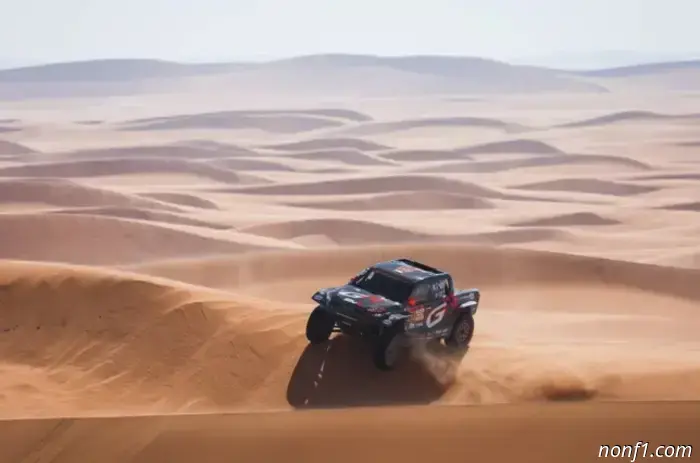
Dakar: Saud Variava secured his second stage victory.
Today Saud Variava, a 20-year-old racer from South Africa, confirmed that last year he did not accidentally become the youngest stage winner in Dakar history in the Cars category. On his four-wheel-drive prototype Toyota Hilux IMT Evo he again reached the finish first, although he beat Henk Lategan, his teammate at Toyota Gazoo Racing and compatriot, by only three seconds. And that after more than 480 km of special stages! More detailed statistics clearly reflect the dynamics of Saud’s progress toward today’s success: after 382 km of the route he was sixth, after 414 km — third, six kilometres later he moved up to second and ultimately won.
Of course, Lategan worked hard to recover after yesterday’s mistake, which cost him the overall lead, and he did claw back one minute on Nasser Al-Attiyah. But the five-time Dakar champion, racing for The Dacia Sandriders team, still sits atop the standings, with Mattias Ekström, the winner of the previous stage, in second. Today he finished third, losing to Variava by 29 seconds, and overall this year the Swedish Ford Racing driver can be regarded as a model of consistency.
On Monday the results among the leading group were quite tight — the time gap between the first car and the one that finished seventh was exactly two minutes. In that group were Al-Attiyah, who posted the fifth time, and Carlos Sainz, Ekström’s teammate, who took sixth.
In the overall classification Williams’ father remains in fifth place, and for him the main thing is that his crew managed to avoid problems today. “It was a tough stage behind us, with stretches where we had to drive over rocks, but we’re glad we reached the finish, and now we’re preparing for the continuation of the marathon,” commented Sainz Sr.
In the Motorcycles class Argentine Luciano Benavides claimed another stage victory; his chances before the start of this Dakar had been judged very modest. But today the Argentine rider for Red Bull KTM Factory Racing again stood out, beating his renowned teammate Daniel Sanders by almost five minutes, which allowed Benavides to lead the overall classification. It’s hard to predict how he will fare from here, but one cannot rule out that he will take the two-wheeled category victory this year.
When success, even an unexpected one, repeats at least twice, it’s hardly a sensation, yet in the Challenger class Pak Klaassen, a 23-year-old racer from the Netherlands, again won the stage, beating… another female racer, Dania Akil from Saudi Arabia. Only third to finish were the best representatives of the male sex — the Dutchmen Paul Spierings and Jan-Pieter van der Stelt.
However, after eight stages Klaassen’s crew sits sixth overall, but trails the leaders, the Spanish duo Pau Navarro and Jan Rosa, by more than one and a half hours and is no longer a contender for victory in this category.
It seems that among the riders preferring ATVs the favorites have already emerged — the crew of American Brock Heger from Sébastien Loeb’s team. This is his second Dakar, and Heger is having an excellent run — suffice it to say he leads by more than 47 minutes and today won the 8th stage of the rally-raid. Earlier he won the 3rd, 4th and 6th stages.
In the heaviest category the crew of Mitchel van den Brink claimed their third Dakar-2026 victory: the Dutch trio compete in the racing truck Dakar Evo 4, prepared by the Czech team MM Technology of Martin Masik. Masik himself finished today’s stage third, behind Vaidotas Žala, yesterday’s winner. The second-place result posted by the Lithuanian on Monday allowed him to rise to second in the overall classification, however van den Brink has already stretched his lead to 38 minutes.
Tomorrow the rally-raid participants face the ninth stage, considered one of the decisive ones. It is the second so-called “marathon stage,” and on it two-wheeled machines and cars will follow different routes, so the off-road crews will not be able to rely on tracks left by motorcycles, meaning all navigation puzzles will have to be solved by themselves. They will also have to deal with technical problems on their own, without the help of their teams’ support crew specialists.
On Tuesday everyone will have to cover 418 km of timed special stages, and it seems likely that not everyone will reach the stage finish. Organizers emphasize that it is on this stage that both people and machines will undergo the toughest test. And everyone will have to spend the night not in the relative comfort of a specially organized bivouac, but simply in tents in the middle of the desert without any “amenities.”

Other articles
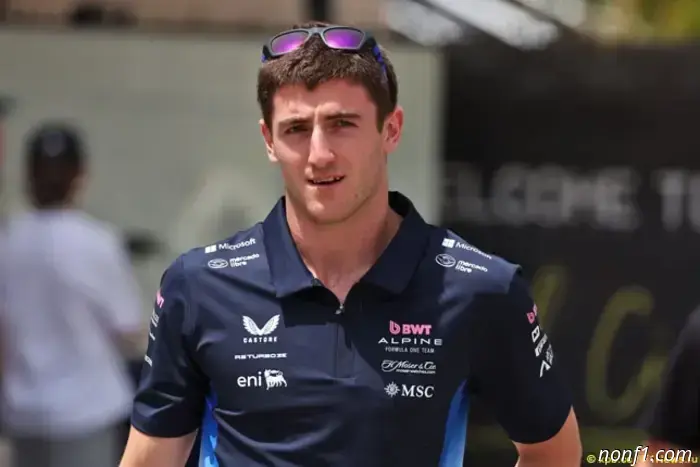 Alpine have ended their cooperation with Jack Duen.
The Alpine team has officially announced the end of its cooperation with Jack Duen.
Alpine have ended their cooperation with Jack Duen.
The Alpine team has officially announced the end of its cooperation with Jack Duen.
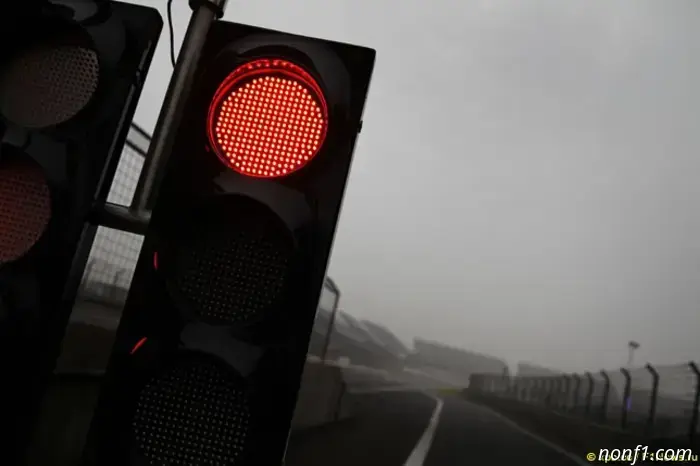 Several teams may miss the start of the tests.
From January 26 to 30, closed tests will be held in Barcelona, where Formula 1 teams will, for the first time, fully run their 2026 cars. According to the Italian press, several teams may miss the start of the tests.
Several teams may miss the start of the tests.
From January 26 to 30, closed tests will be held in Barcelona, where Formula 1 teams will, for the first time, fully run their 2026 cars. According to the Italian press, several teams may miss the start of the tests.
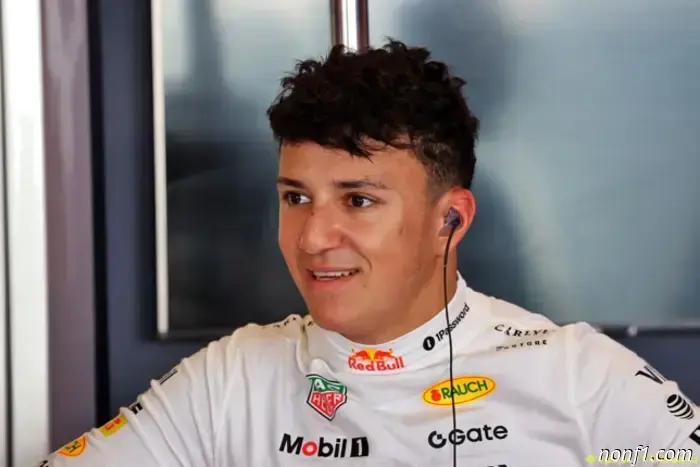 Isaac Hadjar's manager turned out to be his mother.
Isaac Hadjar said that the first person he told about the contract with Red Bull Racing was his mother, Randa, who, as Isaac revealed, is also his manager.
Rosberg's investment fund raised $100 million.
2016 Formula 1 World Champion Nico Rosberg announced that his venture firm Rosberg Ventures had raised $100 million in investor capital for its third investment fund.
Isaac Hadjar's manager turned out to be his mother.
Isaac Hadjar said that the first person he told about the contract with Red Bull Racing was his mother, Randa, who, as Isaac revealed, is also his manager.
Rosberg's investment fund raised $100 million.
2016 Formula 1 World Champion Nico Rosberg announced that his venture firm Rosberg Ventures had raised $100 million in investor capital for its third investment fund.
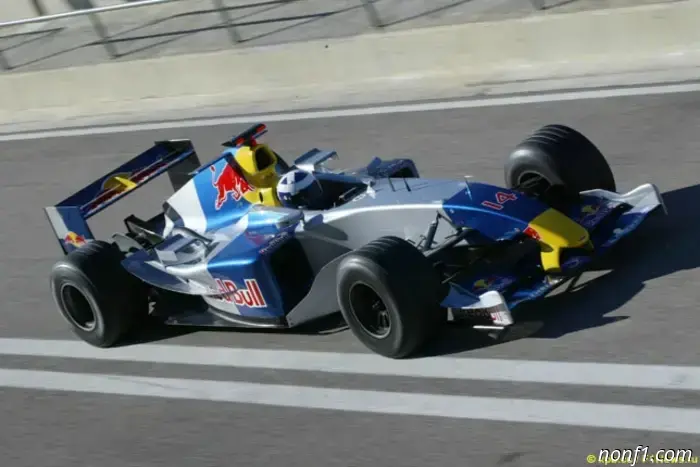 Red Bull hinted at a possible car livery.
The Red Bull Racing press office hinted at a possible color scheme for Max Verstappen's and Isack Hadjar's cars.
Red Bull hinted at a possible car livery.
The Red Bull Racing press office hinted at a possible color scheme for Max Verstappen's and Isack Hadjar's cars.
 January 20, 07:00 MSK: Live stream of Honda's presentation
Next week, on January 20, Honda Racing Corporation will hold a presentation in Tokyo dedicated to the start of its collaboration with Aston Martin and will unveil a next-generation power unit.
January 20, 07:00 MSK: Live stream of Honda's presentation
Next week, on January 20, Honda Racing Corporation will hold a presentation in Tokyo dedicated to the start of its collaboration with Aston Martin and will unveil a next-generation power unit.
Dakar: Saud Variava secured his second stage victory.
Today Saud Variava, a 20-year-old racer from South Africa, confirmed that last year it was no accident that he became the youngest stage winner in the history of the Dakar Rally in the Cars category...