
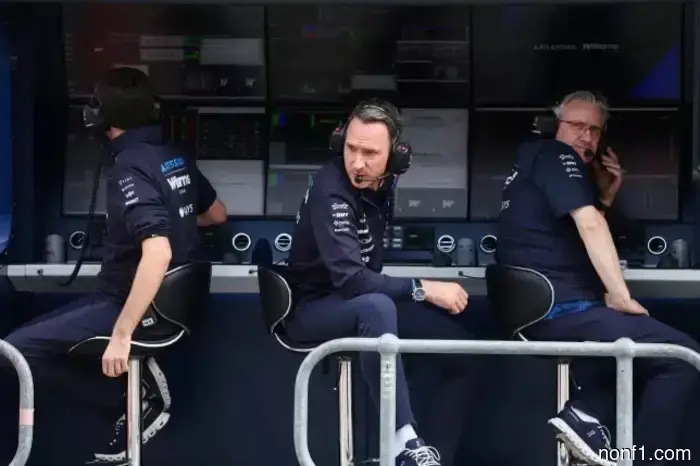
Paul Williams on the challenges of the weekend at Silverstone
In the run-up to the British Grand Prix, Paul Williams, the chief race engineer of Williams, discussed the main factors that will influence both the course of the weekend and its results...
Question: What are the main technical challenges to overcome at Silverstone?
Paul Williams: The track configuration features a characteristic combination of corners: fast turns that are mostly right-handed, and among those that need to be taken at relatively low speeds, there are both left and right turns.
Particular difficulty is presented by the corners from 10 to 14 – teams will need to find the right approach to settings, choosing the optimal ride height and striving to ensure that the car is capable of quick direction changes.
At the same time, the weather can also present us with a task with many variables: the track is located in open terrain with a flat relief, and the grandstands serve as a kind of protection from the rain, so one side of the track can be wet while the other remains completely dry, and this is not unusual.
Question: How does the 2026 regulations affect preparations for the British weekend?
Paul Williams: In terms of energy management at Silverstone, we will face challenging tasks: depending on the grip level, the optimal approaches to the 1st and 9th corners, which are high-speed in nature, can be very different.
The FIA has reduced the energy recovery limit at this track to lessen the impact of the superclipping mode (in this mode, power output is reduced in favor of energy accumulation) in high-speed sections; however, this also reduces the energy reserve that the driver can manage.
In 2026, four zones will be added where the straight-line mode (SLM) is applied, but in wet conditions, the third one, located around the 8th corner (Woodcote), will not be used.
Question: What are the challenges of working with tires at this track?
Paul Williams: In 2026, the three hardest compounds (C1, C2, and C3) will be used, meaning they are one step harder than those we had at our disposal a year ago. Such tires are suitable for this track, where lateral loads are high and longitudinal loads are not so great, with the left side of the car being loaded the most.
On the straight sections between the corner sequences, there is an opportunity to cool the tire surface somewhat, and a moderate degree of abrasiveness of the surface should ensure stable grip throughout the weekend.
Preparing the tires for a fast lap in qualifying should be easier than at several previous events, aided by the length of the lap and the high-speed nature of the track. We expect that the front left tire will wear out the most, while the rear tires will overheat, although to some extent, the hard compounds should somewhat reduce this negative effect.
Question: What can be said about the strategy for the upcoming race?
Paul Williams: Since the tires this year are harder, this will definitely allow for completing the distance with one pit stop – provided that the race is not neutralized by the appearance of the safety car or the introduction of the virtual safety car (VSC).
All compounds, including Soft, can be used in the race, so there can be many tactical options; teams may even make some compromises when deciding on tire selection for the sprint, in order to optimize the tactical scheme for the Grand Prix.
Considering the 80% probability of a safety car appearance (in this regard, Silverstone ranks 4th among the tracks on the calendar), some drivers will try to stretch the segments of the distance as much as possible, while others may take the risk of making an additional pit stop, sacrificing position in the process.
Weather often intervenes during the weekend at Silverstone, but for now, the forecast promises dry and sunny conditions.
Paul Williams on the challenges of the weekend at Silverstone
In the run-up to the British Grand Prix, the chief race engineer of Williams spoke about the main factors that will influence both the course of the weekend and its results...