
Williams drivers on the 2026 technical regulations
The Williams team didn’t limit itself to simply summing up the past season; its drivers also shared some comments about the major changes that will take place next year when Formula 1 switches to next-generation machinery.
Car dimensions and shape
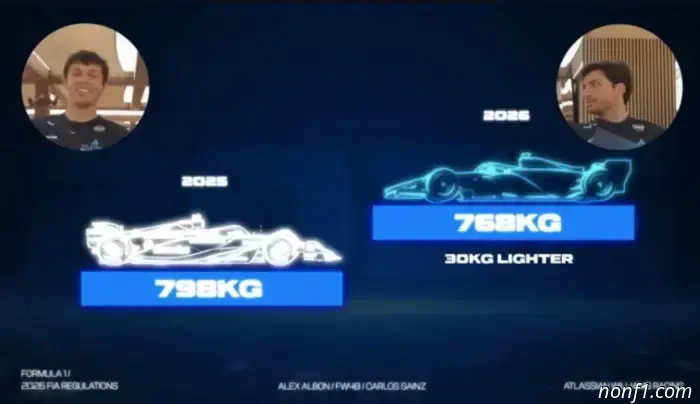
Carlos Sainz: The cars in 2026 will be 200 mm shorter — that’s 20 cm — and 100 mm narrower. They will also be 30 kg lighter. Overall, they will become more compact. The tyres will be smaller too — it will be a version of the rubber used now but reduced in size by 5%.
Alex Albon: It’s important that the car weight has been reduced so they become a bit faster. Realistically speaking, I hope the claustrophobic feeling on street circuits will be less obvious. Maybe there will be more overtaking opportunities. I think the current cars are too big.
Carlos Sainz: I think Formula 1 has chosen the right development path, because when the 2026 regulations are replaced by the next set, the cars will become even smaller.
Environmentally sustainable fuel
Alex Albon: I like that Formula 1 is moving to fully synthetic fuel, which is produced either from biomass — that is, plant-based feedstock — or from synthetic feedstock, or a combination of the two.
Emissions won’t drop to zero yet, since it’s still hydrocarbon fuel, but basically they are limited to the process of producing that fuel.
Carlos Sainz: So it’s a healthier situation. That fuel is much “cleaner.”
Alex Albon: Yes, and I believe that fuel was already used in Formula 2 in 2025. There didn’t seem to be any problems.
DRS replaced by other technologies
Alex Albon: The DRS system will no longer be used; instead we’ll have front and rear wings made up of three elements. Two of them will be movable, which will increase straight-line speed.
Carlos Sainz: Will you miss DRS?
Alex Albon: You know, I have a feeling that the system will still remain, but now it will be not only on the rear wing but also on the front wing. Can I put it that way?
Carlos Sainz: Yes, that’s right. However, it’s not used for overtaking, but to increase the car’s speed.
Alex Albon: That’s true, but we’ve already done some laps of the new car on the simulator, and thanks to the new systems it’s become a bit more balanced. Before, when DRS opened, the car’s behavior shifted toward oversteer.
Carlos Sainz: Consequently, safety will increase somewhat. So, we’re talking about SLM — i.e., Straight Line Mode (“a mode that activates on the straights”). So start learning the new terms.
Alex Albon: I think that will be interesting.
Carlos Sainz: There will also be what they call an “overtake mode,” although I think in reality it’s a high-power mode. But essentially it’s a new overtaking mode, and the car will have a new overtaking button that, when pressed, gives us extra power.
Although I don’t fully understand how these new rules will work.
Alex Albon: We don’t know yet, but effectively the car will get maximum power in an instant, although it’s not without constraints.
Carlos Sainz: For that you’ll need to get within a car-length of your rival.
Alex Albon: The thing is, the behaviour of the new cars will depend heavily on battery charge. Of course, in the next corner you can make an overtake using all the power of the power unit, but in the following corner you’ll most likely have to save battery charge.
Personally, I think the probability of overtakes next year will increase, but so will the likelihood that the rival will launch a successful counterattack in the very next corner.
Carlos Sainz: Yes, I also think that next year this will cause odd situations. For example, we might see overtakes in parts of tracks where there usually weren’t any.
Optimising battery usage
Carlos Sainz: Because of all this, lap time will depend more than ever on your ability to keep the battery charge at the highest possible level. That means keeping engine revs in the right range, and we’ll have to work with the engineers to make the car efficient.
I think approaches to this will be very different from the “attack flat-out” principle. We’ll have to find what I call a “formula for efficiency.”
Alex Albon: I think at the very beginning all this will be quite unclear. Because next year, in some cases, to be faster you’ll have to go slower. What I mean is that somewhere you’ll need to save more energy, but that will pay off in the next corner, on the following part of the lap, or at a later stage of the race.
Drivers will have to adapt to all this, and the most important factor will be teams’ use of simulators to develop optimal approaches both for driving a single lap and for a race distance. In short, we’ll have to rack our brains.
Carlos Sainz: I think it can be simplified: just because you attack more aggressively doesn’t mean you’ll go faster.
Alex Albon: But it’s all yet to be thought through.
Carlos Sainz: A wise approach.
Alex Albon: It seems to me the main changes will be related to the new power unit, and the behaviour of the car itself won’t change that much.
Carlos Sainz: I think the new cars will accelerate very quickly. Although personally I want to rest first during the winter break.
Alex Albon: Agreed. So, I hope we were able to explain at least something to you. I don’t know if you learned anything new, though I wouldn’t be surprised if we only made things more confusing. See you next year!

Williams drivers on the 2026 technical regulations
Williams didn't limit itself to reviewing the past season; its drivers also shared some comments about the major changes that will take place next year...