
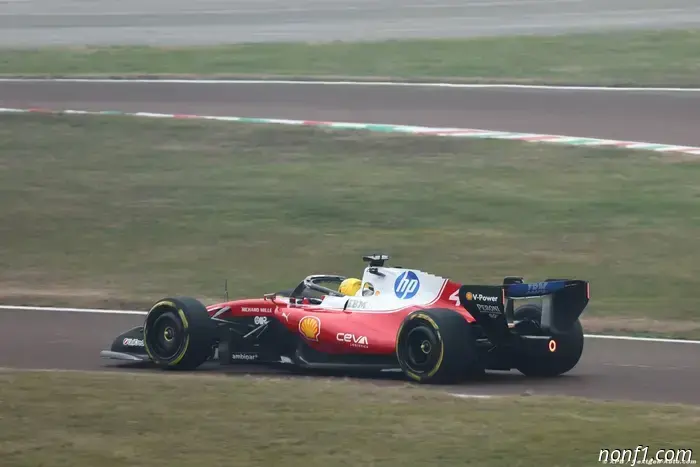
Ferrari has begun developing an engine similar to Mercedes for 2027.
Ferrari's strategy reportedly focuses on a revamped connecting rod.
Competing Formula 1 teams are thought to be nearing a consensus on the contentious Mercedes power unit design, amid widespread speculation linking a new compression technique to the German team's impressive performance under the 2026 regulations. Recently, engineers across the pit lane have been discussing a theory involving a small auxiliary volume—allegedly around one cubic centimetre—that connects to the combustion chamber through a narrow passage near the pre-chamber spark plug located at the top of the cylinder.
Interestingly, similar discussions have emerged regarding the Red Bull-Ford program. When asked by Australia’s Channel 9 whether such designs constitute cheating, former Red Bull team principal Christian Horner dismissed the idea. "That’s a significant claim," Horner stated. "Formula 1 is about pushing boundaries. It's about how you interpret the regulations. The teams that are too conservative never find themselves at the front. You need to challenge the limits."
Meanwhile, well-known Italian commentator Leo Turrini suggests that Ferrari is already strategizing for its response—not just for 2026, but for the future. In his Quotidiano column, Turrini asserts that Ferrari's engine chief Enrico Gualtieri has greenlit the development of a 2027 power unit featuring major modifications aimed at achieving a dynamic compression ratio. Turrini claims that Ferrari suspects the FIA, led by single-seater director Nikolas Tombazis, considers Mercedes' concept to be fully legal, prompting Ferrari to explore its own interpretation.
Ferrari's focused approach is reportedly centered on a reengineered connecting rod, which employs a high thermal expansion coefficient to mitigate compression losses as temperatures rise. If successful, this solution is expected to reach the dyno in mid-2026, with any potential on-track debut unlikely before 2027. The expected advantage? Turrini estimates a boost of between 5 and 10 horsepower.
Following Ferrari's challenging 2025 season, expectations remain tempered. When inquired about the performance of the SF26, former Ferrari driver Ivan Capelli chuckled. "Next question?" he replied. When pressed further, Capelli adopted a more hopeful tone. "The SF26 has implemented several innovative solutions," he noted. "The new regulations enable engineers to take different approaches—there isn't only one way to interpret them.
"Ferrari has an obligation to compete," he continued. "I anticipate they will be among the top teams."

Ferrari has begun developing an engine similar to Mercedes for 2027.
Formula 1 | Competing teams in Formula 1 are thought to be approaching the contentious Mercedes power unit design, amidst widespread speculation regarding a new (…)