
Austrian Grand Prix: Track and Statistics
FORMULA 1 LENOVO AUSTRIAN GRAND PRIX 2026
Date
Circuit
Lap Length
Laps
Distance
27-29/06/2025
Red Bull Ring
4318 m
71
306.452 km
Official Website
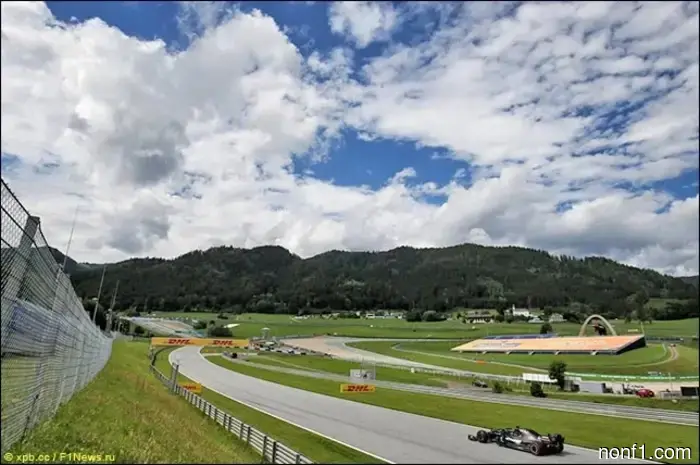
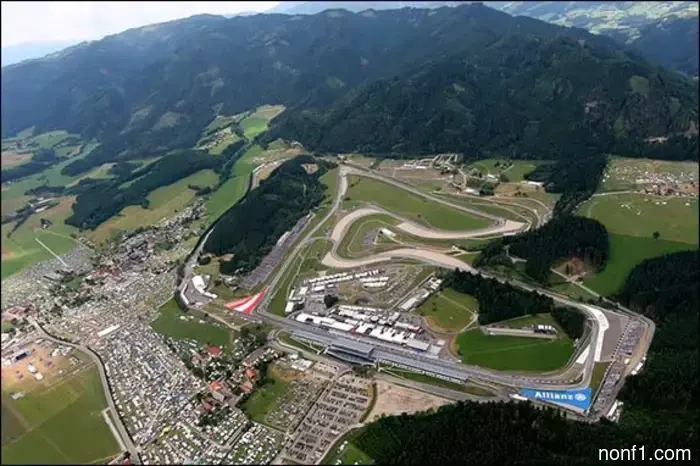
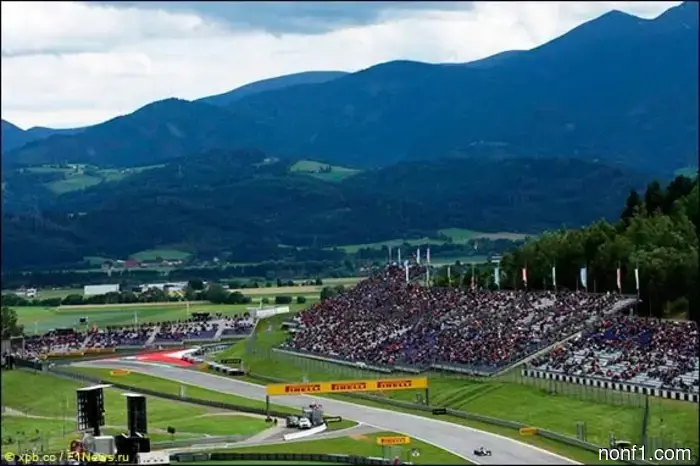
The Austrian stage returned to Formula 1 in the 2014 season. The race at the circuit in Spielberg, which has changed its name three times – Österreichring - A1 Ring - Red Bull Ring – returned to the championship thanks to the efforts of former Red Bull co-owner Dietrich Mateschitz. For two years, the track in Spielberg hosted series of two consecutive events – Austria and Styria, and then for three consecutive years – an event with a Saturday sprint. This year, the weekend will take place in the classic format. The contract with the track has been extended for an incredibly long term – until 2041. Only the Miami track has a contract of the same duration so far. The configuration corresponds to that used in 2003 but has been brought in line with modern standards – safety zones have been expanded, certain sections are equipped with TecPro barriers, and a new press center and other facilities have been built. Located in a very picturesque area, the old-school track has acquired a new look. The names of most corners, which were named after drivers, have changed. The Jochen Rindt corner remains, and in 2019 the Niki Lauda corner reappeared – named after the first corner of the track.
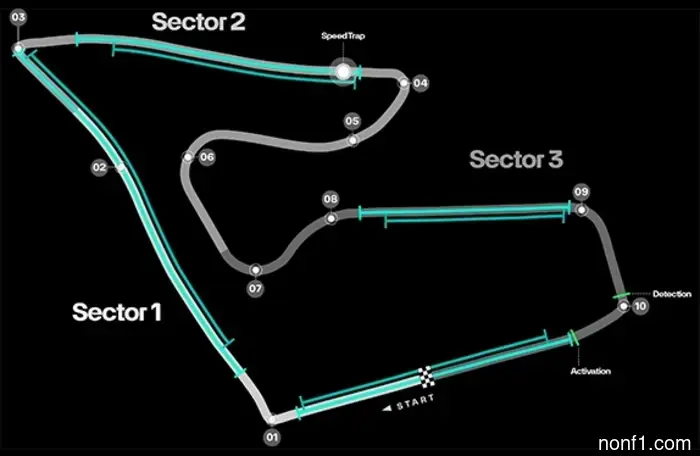
The lap at the Austrian track is quite short – only shorter now in Monaco, São Paulo, Zandvoort, and Mexico, so the results in Spielberg are traditionally tight. The lap record belongs to Valtteri Bottas – driving a Mercedes in the final qualifying session of 2020, the Finn completed his best attempt in 1:02.939. There are only ten corners in Spielberg – fewer than at any other Formula 1 track, but in fact, there are even fewer – the second, fifth, and eighth corners can be taken with the throttle fully pressed. The long straight in the first sector allows for attacks under braking, but the Austrian track is not the easiest for battling for position. The track in Spielberg demands good handling – the car must be as responsive as possible, provide good mechanical grip at low speeds (corners 1, 3, and 4), and have high efficiency in the fast corners 6-7 and 9-10. Engineers will have to find the traditional compromise between downforce and speed. The height difference of 63.5 meters between the lowest point – the start-finish straight, and the highest – the third corner – is the second in the calendar, yielding only to Spa (102.2 meters). There are three serious braking points on the track – before corners 1, 3, and 4. On the short lap, the brakes do not have time to cool down, which increases their wear. Teams are forced to use the maximum configuration of the brake cooling system, which causes the front tires to heat poorly – and on the short lap, it is difficult to find the optimal balance between the temperature of the front and rear tires. Due to the four straights, the throttle is fully pressed for most of the lap, but due to the small number of serious braking points, achieving effective energy recovery is very challenging. The track is known for its high curbs – in the first, sixth, and seventh corners, the load on the suspension is particularly high. Like Interlagos, the track in Spielberg is at a decent height above sea level – about 640 meters, so the turbo will spin to higher revolutions to compensate for the lower air pressure.
Diego Ioverno, Ferrari: “Races in Spielberg usually feature thrilling battles right to the finish, as the track configuration promotes overtaking, and the wide safety zones encourage drivers to push to the limit. This aspect has led to certain problems in recent years. The rules state that one of the car's wheels must always be within the track limits to avoid violations that lead to penalties – in qualifying, this results in lap time being canceled, and in the race, three violations lead to a five-second penalty. In recent years, the FIA has decided to adhere to the letter of the law, which has led to an exponential increase in violations and an urgent need to address this issue. The most effective solution is one that physically prevents breaching the track limits. For several years, high orange curbs were used for this purpose, which could damage the car and send it flying. Today, gravel traps are used much more frequently, which significantly reduce speed. But Spielberg remains a track where penalties for breaching limits are more common than elsewhere.”
Best Results from the Austria Grand Prix 2025 Sessions
Event
Weather
Driver
Team
Time
First Practice
Sunny. Dry
D. Russell
Mercedes
1:05.542
Second Practice
Sunny. Dry
L. Norris
McLaren
1:04.580
Third Practice
Sunny. Dry
L. Norris
McLaren
1:04.324
Qualifying
Sunny. Dry
L. Norris
McLaren
1:03.971
Best Lap in the Race
Sunny. Dry
O. Piastri
McLaren
1:07.924
Weekend Schedule
You can follow all Formula 1 session progress on our live broadcast page.
Austrian Grand Prix Schedule. Moscow Time
Day
Event
Time
26/06
Formula 3. First Practice
10:55-11:40
26/06
Formula 2. First Practice
12:05-12:50
26/06
Formula 1. Car Presentation
13:00-14:00
26/06
Formula 1. First Practice
14:30-15:30
26/06
Formula 3. Qualifying
16:00-16:30
26/06
Formula 2. Qualifying
16:55-17:25
26/06
Formula 1. Second Practice
18:00-19:00
27/06
Formula 3. Sprint (21 laps or 40 minutes + 1 lap)
11:05-11:50
27/06
Formula 1. Third Practice
13:30-14:30
27/06
Formula 2. Sprint (28 laps or 45 minutes + 1 lap)
15:15-16:05
27/06
Formula 1. Qualifying
17:00-18:00
28/06
Formula 3. Race (26 laps or 45 minutes + 1 lap)
09:40-10:30
28/06
Formula 2. Race (40 laps or 60 minutes + 1 lap)
11:10-12:25
28/06
Formula 1. Drivers' Parade
14:00-14:30
28/06
Formula 1. Austrian Grand Prix (71 laps or 120 minutes)
16:00-18:00
Tire Sets Provided to Teams for the Weekend
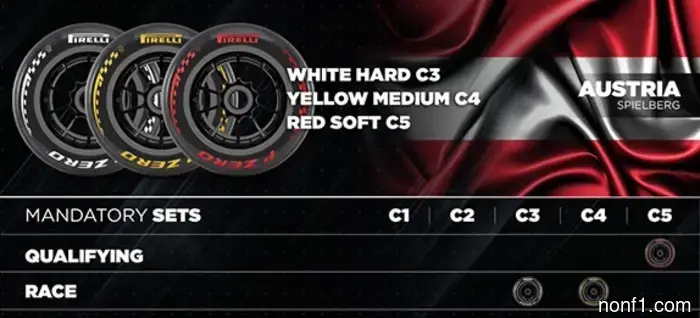
Tire manufacturers will bring the softest compounds – C3, C4, and C5 as Hard, Medium, and Soft. Mechanical wear is not a determining factor in Austria, where tires wear mainly due to overheating. The asphalt was laid several years ago and has a high degree of micro and macro abrasiveness, which in itself leads to tire overheating. Thanks to the layer of worn rubber on the asphalt left after numerous racing events throughout the year, grip will be good – and will improve even more over the weekend. During accelerations, the rear tires are loaded and wear out more, while during braking on descents – the front ones. The Red Bull Ring has a significant height difference – 63 meters, the second highest in the calendar. Powerful new power units will provoke wheel lock-ups, especially on descents. Another important aspect is related to the altitude. At over 600 meters, the thin air creates less downforce, which can also lead to tire slipping. High air temperatures will also play a role, but the track is located in the mountainous Styria, where surrounding forests sometimes create conditions for sudden weather changes. Mario Isola: “At the Red Bull Ring, tires are constantly subjected to high loads. Cars complete a lap of 10 corners in a time just exceeding a minute, with the straights not being that long, meaning the tires are always working without a break. The asphalt surface is quite old, which explains its relatively high abrasiveness, but the level of grip at the beginning of the lap is also high. Effective accelerations and braking are key elements, but it is necessary to work with the tires in such a way as to avoid overheating. Drivers who cannot cool their tires properly may find it difficult to fend off
Other articles
 Austrian Grand Prix: Round Numbers
Round numbers before the Austrian Grand Prix...
Austrian Grand Prix: Round Numbers
Round numbers before the Austrian Grand Prix...
 Austrian Grand Prix: Comments before the stage
Comments from pilots and teams before the Austrian Grand Prix...
Austrian Grand Prix: Comments before the stage
Comments from pilots and teams before the Austrian Grand Prix...
 Austrian Grand Prix: Stage Preview
The power dynamics change with each race, and the European part of the season will be rich in changes...
Austrian Grand Prix: Stage Preview
The power dynamics change with each race, and the European part of the season will be rich in changes...
 Austrian Grand Prix: Round Numbers
Round numbers before the Austrian Grand Prix...
Austrian Grand Prix: Round Numbers
Round numbers before the Austrian Grand Prix...
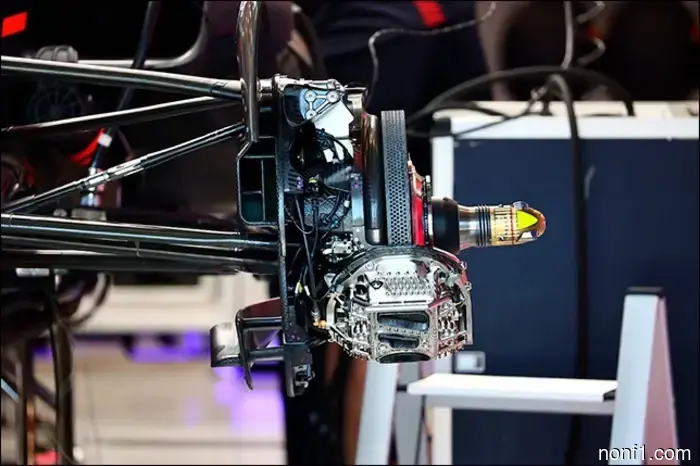 Austrian Grand Prix: The point of the most serious braking
Brembo has released a video about the point of the most serious braking on the track in Spielberg.
Austrian Grand Prix: The point of the most serious braking
Brembo has released a video about the point of the most serious braking on the track in Spielberg.
Austrian Grand Prix: Track and Statistics
The combination of slow turns and fast straights requires a compromise between downforce and speed...