
Martin Brundle on the results of the Belgian Grand Prix
Former Formula 1 driver and Sky Sports F1 commentator Martin Brundle summarized the Belgian Grand Prix...
The Spa circuit is beautifully arranged and nearly perfected, but in the old good tradition, every day new rules appear upon entering the territory and moving around it. To be fair, the area is vast, and controlling a large number of fans is challenging.
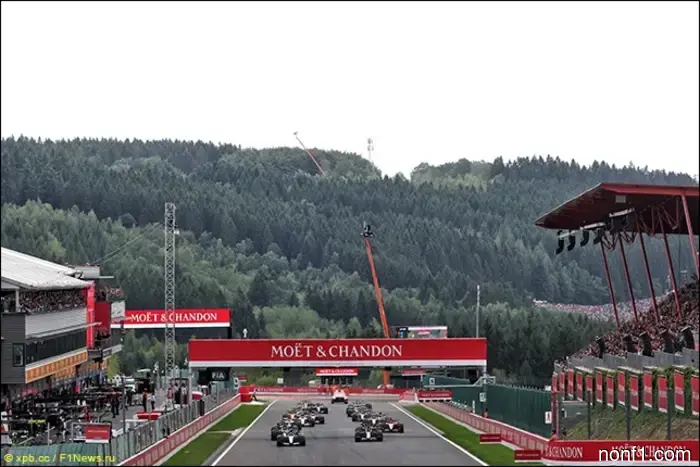
As usual, during the Friday practice, I stood by the track. The cars against the backdrop of the packed grandstands looked fantastic. I've been racing here for 45 years, but I couldn't believe my eyes seeing such a large number of spectators.
It was interesting to observe how the drivers tried to cope with the excess power while lacking grip on the exit from medium-speed chicanes. But, as in Silverstone, there was a story behind it, and the drivers behaved cautiously throughout the weekend, trying not to criticize the situation too emotionally.
We have long lost the corners of Eau Rouge and Raidillon in their former beauty – with cars that have high downforce and tires providing excellent grip, the section from the first corner – the La Source hairpin – to the fifth – the Les Combes chicane, has effectively become one long straight.
This year, on this high-speed track, the longest on the calendar, the engine has to be used to charge the batteries. As a result, the entry speed into corners like Pouhon in Spa has decreased so much that it has effectively turned into a winding straight. The same story applies to the corners of Copse, Becketts, and Stowe in Silverstone. And the same problem exists in Suzuka. On these tracks, we have lost the high-speed corners that drivers love so much.
Fortunately, this weekend in Budapest, there will be no such problems – there are simply no truly high-speed corners there.
We have long been aware of these issues, and attempts are being made to resolve them – in 2027 and 2028, we will see some changes, but the last two races have clearly confirmed that we need to radically change the concept of today's power unit, and the sooner, the better.
"Childish" reliability issues with power units during regulation changes have always existed, but the closer we get to the summer break, the more often we hear drivers' comments about "energy usage problems" and "empty battery."
George Russell is clearly not a direct descendant of Alessandro Volta, Michael Faraday, Thomas Edison, or Nikola Tesla, as the batteries in his car never have the necessary charge at the right moment.
Whether it's about a lack of speed on the straights compared to his teammate Antonelli in qualifying, for whatever reasons that may occur, or during the climb up the hill in Spa before the fifth corner on the first lap.
Antonelli had a good start, just like Verstappen in the Red Bull. Max made what seemed to be a clever maneuver, overtaking Kimi before Eau Rouge – at the foot of the climb, but his comments after the race suggest that his car simply used too much battery charge. This implies that he had no part in what seemed to be a clever plan.
Both Mercedes drivers – Antonelli and Russell – started with a charge below what was necessary, and this particularly affected George's car dynamics – it lost pace on the long climb to the critical braking point before the fifth corner, where he was overtaken by three, including Lewis Hamilton.
George impressively braked late, trying to compensate for the lack of speed with a different approach to the corner, and found himself on the outside of Lewis, leaving him room to maneuver.
Lewis's car, closely following Max, shifted slightly and touched George. Russell was spun around, and he retired from the race, which seriously complicated his situation in the title fight.
On the first lap, stewards have greater freedom of action, as drivers are in a tight group, all with full tanks, and brakes and tires are not yet warmed up. In the broadcast, I called it a racing incident unless the stewards deemed that Lewis lost control of his car, which apparently did not happen.
Returning to the pits on a scooter, George also called it a racing incident, although he was much more concerned about the power drop issue.
Ferrari also referred to the incident as a racing incident, although one might assume they would do so. But most of my acquaintances agreed with this. Apparently, having some additional information, the stewards imposed a 5-second penalty, reducing it from the standard 10-second one. This may have cost Lewis a podium, but it's definitely hard to say.
Later in the race, Charles Leclerc attacked Oscar Piastri in the braking zone of the fifth corner – a collision occurred, slightly damaging the aerodynamic elements of Piastri's car. In my opinion, this was a clear maneuver in the braking zone, which according to the rules entails a penalty – from a black flag to a drive-through penalty.
But in this case, the stewards considered the relative position of the front axles, determining who had the right to enter the corner first. Leclerc's demonstrative reaction in the room before the podium when this episode was shown on the screen says everything that needs to be known about it.
For Hamilton, the weekend was not easy. A crash in practice, a five-second penalty due to the incident with Russell, and a situation where he nearly ran over one of his mechanics during a pit stop, through no fault of his own. This incident resulted in a penalty for the team, not a racing penalty, and therefore Lewis probably breathed a sigh of relief learning he finished fourth – likely for the first time in his life.
Piastri confidently ran the race and finished fifth in a damaged car, which lacked the previous pace – at the speed he had in the first stint, he could have hoped for a podium.
Lando Norris drove excellently throughout the weekend but had to start 13th due to the need to replace the electronic control unit of the power unit beyond the allowable limit set by the regulations, which are designed to curb costs so that wealthy teams cannot simply throw new parts at the car every weekend.
Interestingly, McLaren decided not to use the VSC mode announcement and delayed Lando Norris's pit stop until lap 30, where he was able to get rid of the starting set of Hard tires. As a result, he had to exert too much effort to catch up with Isaac Hadjar, who started on the Red Bull from the back rows – also due to the replacement of power unit elements, and finished in a high sixth place.
Martin Brundle on the results of the Belgian Grand Prix
Former Formula 1 driver, Sky Sport F1 commentator Martin Brundle summarized the Belgian Grand Prix...