
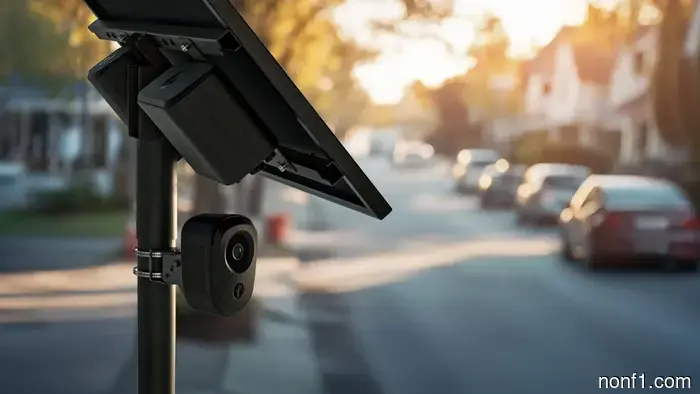
Flock Acknowledges Mistakes That Endangered Innocent Individuals, Revamps Police Search Regulations
The latest car news and reviews, no nonsense.
Our daily newsletter, delivered for free every weekday, brings you the most important stories straight to your inbox.
On Thursday, Garrett Langley, the Founder and CEO of Flock Safety, acknowledged police misuse of Flock’s services and stated, “I’m sorry the system has failed you.”
Flock addressed the incident involving my wife and me, where we were surrounded by police who mistakenly believed I had committed grand theft auto with a $155k Range Rover. This was due to the Los Angeles Sheriff’s Department entering a partial license plate into the National Criminal Information Center database, leading to alerts from Flock cameras. In a press release, Flock explained, “A recent incident involved a wrongful traffic stop concerning an auto journalist. The key takeaway is straightforward: an alert should be seen as a lead, not a conclusion, and must be confirmed by an officer.” The emphasis was theirs, not ours. While avoiding accountability and shifting it to law enforcement, Langley announced significant changes.
Langley stated that Flock will implement new mandatory audit monitoring to identify unusual activity and repeated queries. Furthermore, all searches using Flock’s system will now require case codes for law enforcement to justify their searches, except in emergencies, which will still be evaluated.
According to Flock, users who conduct unusual searches, likely characterized by repeated patterns, will be locked out of the system pending a review by an administrator.
Additionally, Flock will reduce its default data retention period to seven days, which previously varied from state to state in accordance with local regulations. Some states permitted data retention for only 7 or 21 days, while others allowed for 30 or even up to 100 days.
Importantly, the new seven-day retention period is now the default suggestion. Flock stated that “Existing customers will maintain their current, democratically approved retention periods.”
Langley mentioned, “Historically, I felt uncertain as a chief executive of a private company about whether I should make these decisions. I questioned whether it was my role to dictate how long data should be kept.”
The BBC reported that he subsequently aligned with organizations like the American Civil Liberties Union and the Electronic Frontier Foundation, which argue that police should require an active case number to access Flock’s data. Langley acknowledged, “They’re right. I think it should be required.”
Langley conveyed to CNN, “What’s changed for me is realizing that we have a responsibility, perhaps even an obligation, to the communities we serve to set the standard.”
Flock also announced it will launch a new Offense Filtering feature, allowing cities to select which types of offenses can be accessed by other agencies through their cameras.
Langley affirmed, “We are not perfect, so we will continue listening, improving, and working together to establish a better standard for public safety technology." He indicated that these changes will be rolled out in the upcoming weeks and months.
Have a tip? Reach out to us at tips@thedrive.com.
Other articles
 Zak Brown: Fornari has chances in Formula 1
The speed of the 21-year-old Italian impressed the management...
Zak Brown: Fornari has chances in Formula 1
The speed of the 21-year-old Italian impressed the management...
 On August 27, Colov will conduct tests with Racing Bulls.
The tests will allow Tsolov to score the necessary points for the super license to participate in Friday's training...
On August 27, Colov will conduct tests with Racing Bulls.
The tests will allow Tsolov to score the necessary points for the super license to participate in Friday's training...
 Lindblad: This year I am living my dream!
The only debutant of the season, Arvid Lindblad, is pleased with how everything is turning out – his dream of Formula 1 has come true…
Lindblad: This year I am living my dream!
The only debutant of the season, Arvid Lindblad, is pleased with how everything is turning out – his dream of Formula 1 has come true…
 On August 27, Colov will conduct tests with Racing Bulls.
The tests will allow Tsolov to score the necessary points for the super license to participate in Friday's training...
On August 27, Colov will conduct tests with Racing Bulls.
The tests will allow Tsolov to score the necessary points for the super license to participate in Friday's training...
 Lightning McQueen signed a contract with Formula 1!
The champion of the "Piston Cup," the main character of the animated film "Cars," Lightning McQueen, will become the new face of the collaboration between Disney and Formula 1...
Lightning McQueen signed a contract with Formula 1!
The champion of the "Piston Cup," the main character of the animated film "Cars," Lightning McQueen, will become the new face of the collaboration between Disney and Formula 1...
 In Argentina, preparations are underway for MotoGP and they are awaiting Formula 1.
The Argentine Grand Prix was held twenty times from 1953 to 1998 – and may return in 2028 or 2029 if negotiations go well.
In Argentina, preparations are underway for MotoGP and they are awaiting Formula 1.
The Argentine Grand Prix was held twenty times from 1953 to 1998 – and may return in 2028 or 2029 if negotiations go well.
Flock Acknowledges Mistakes That Endangered Innocent Individuals, Revamps Police Search Regulations
Flock CEO Garrett Langley states that wrongful stops indicate a malfunctioning system, and he is enforcing stricter search protocols while reducing data retention.