
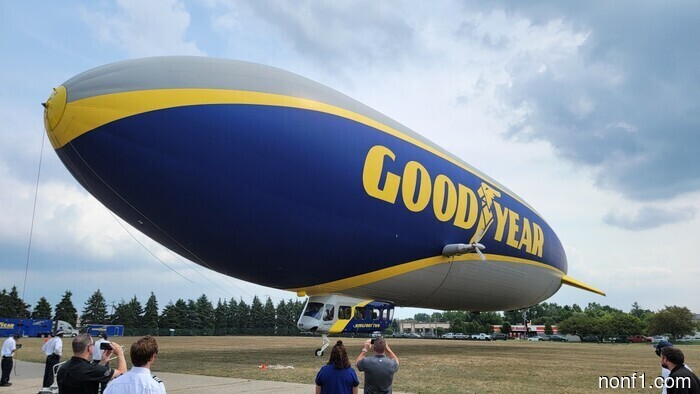
Flying in the Goodyear Blimp: Surprisingly Similar to a Boat
The latest in car news and reviews, no nonsense.
Our complimentary daily newsletter delivers the most important stories right to your inbox every weekday.
“It’s the same familiar tale. Boy meets girl, boy loses girl, girl finds boy, boy forgets girl, boy remembers girl, girl tragically dies in a blimp accident over the Orange Bowl on New Year’s Day.”
“Goodyear?”
“No. The worst.”
I travel frequently; it’s part of the job. I’m also quite inquisitive, and that curiosity has often led me to delve deep into aviation accidents, often the night before or the day of a flight. I can’t explain why, but reading about unavoidable death doesn’t cause me anxiety like it does for others. Blame it on a childhood spent watching educational disaster shows on TV, but if there’s a way for a plane to crash, I’ve likely read the detailed NTSB report. What can I say? I find closure comforting.
As a millennial raised during the height of the CD-ROM era, I have a peculiar relationship with blimps. What could possibly connect the two? If you also experienced the 1990s, you may remember having Microsoft’s Encarta. Taking advantage of the format’s increased media capabilities, the CD-ROM editions included video clips of certain entries. Among the few highlighted clips was footage from the Hindenburg disaster. I can’t count how many times I watched that loop as a child. I’ve undoubtedly contributed to the cultural phenomenon that brought “Oh, the huge manatee!” to prominence.
But as I board Goodyear’s “Wingfoot Two,” I’m not thinking about a flaming zeppelin. Instead, that silly quote from The Naked Gun pops into my head, making me chuckle with genuine excitement about the chance to ride in an airship.
Contrary to what you might believe about this experience, most of my time in the air is spent in less luxurious surroundings. The Wingfoot Two accommodates seven passengers; there are no bad seats aboard.
The term “ship” in airship should be taken seriously. If you think about it, a blimp is essentially a submarine turned inside-out. The exterior retains the helium instead of keeping water out (though it does that to some extent), but the basic principles of buoyancy still hold. To understand wind is to understand fluid dynamics.
Since it behaves like a vessel, it’s treated as one. Boarding the Wingfoot Two resembles getting onto a ferry that’s already in motion. The gangway ladder has wheels, allowing it to move with the blimp as it turns around its mooring cable. The blimp can drift at a leisurely pace or a brisk jog, and that speed can change suddenly. If you fall in front of the ladder, you risk being run over by a 20,000-pound party decoration.
Furthermore, because the Wingfoot Two is essentially a massive gas bag with propellers, its natural tendency is to ascend. While the Goodyear team juggles a busy schedule of passenger rides, they seldom truly “land” the airship between journeys. The passengers themselves act as ballast, and new riders board before those from the previous ride disembark, ensuring the ship stays adequately weighted. During this time, the pilots are practically maneuvering the ship downward just to keep it from soaring away.
Once the last of the previous ride’s passengers has disembarked and the boarding hatch is secured (with a window open for comfort; there’s no AC onboard), we receive a brief safety orientation, and then we're ready for takeoff. The ground crew releases us, and the ship tilts upwards immediately as the pilot adjusts the props for vertical ascent.
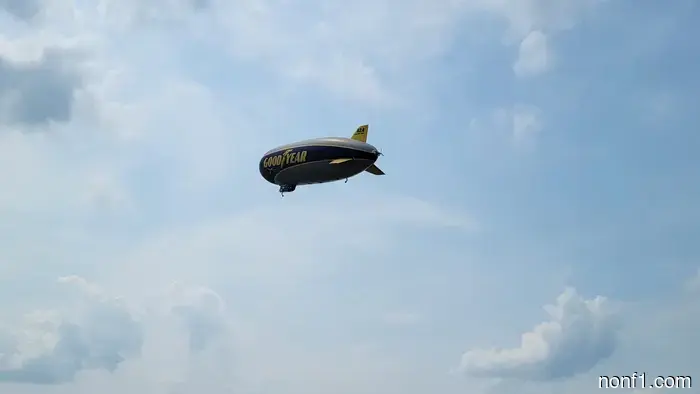
A plane glides. A helicopter churns the air beneath it. A blimp… floats. It’s an eerie sensation; you feel every thermal and gust of wind. Occasionally, the entire craft veers sideways unexpectedly. But it's gentle, muted by the sheer size of the helium-filled envelope uplifting you. We’re allowed to move around the cabin at our “cruising altitude” of 1,000 feet, though we’re advised to hold onto the various rails until we establish our “sea legs.”
Since the Wingfoot Two’s props are solely for thrust and not lift, they are relatively quiet. One crew member stands facing us throughout the flight to deliver the standard “tour” and never needs to raise his voice, even with the windows open for ventilation. It’s not silent, but it’s not disruptive either.
It’s easy to picture this as the pinnacle of luxury travel. The ride is smooth, and the views are breathtaking. Yet, even a light gust serves as a reminder of how much we depend on the weather. Despite being subdued, the physics are undeniable. While the Wingfoot Two may resemble a torpedo, it’s essentially a sail; it’s just as aerodynamic as anything devised over a century ago—which is







Other articles
 Audi Is Not Ready to Part Ways with the Five-Cylinder Engine: TDS
An Audi executive states that he fully understands the significance of the engine to the brand, and that efforts are being made to ensure its longevity in light of new emissions regulations.
Audi Is Not Ready to Part Ways with the Five-Cylinder Engine: TDS
An Audi executive states that he fully understands the significance of the engine to the brand, and that efforts are being made to ensure its longevity in light of new emissions regulations.
 Japan Recently Sent a 1,000-Foot Bullet Train to Another Nation
Japan is not the only nation where you can experience the Shinkansen. Taiwan has recently received the first of 12 new bullet trains.
Japan Recently Sent a 1,000-Foot Bullet Train to Another Nation
Japan is not the only nation where you can experience the Shinkansen. Taiwan has recently received the first of 12 new bullet trains.
 Japan Recently Sent a 1,000-Foot Bullet Train to Another Nation
Japan is not the sole country where you can experience the Shinkansen. Taiwan has recently received its first two of twelve new bullet trains.
Japan Recently Sent a 1,000-Foot Bullet Train to Another Nation
Japan is not the sole country where you can experience the Shinkansen. Taiwan has recently received its first two of twelve new bullet trains.
 Soaring in the Goodyear Blimp: Unexpectedly Similar to a Boat
The Goodyear Blimp emerged in the early days of the automobile. Although society has progressed, airships still evoke a sense of nostalgia within us.
Soaring in the Goodyear Blimp: Unexpectedly Similar to a Boat
The Goodyear Blimp emerged in the early days of the automobile. Although society has progressed, airships still evoke a sense of nostalgia within us.
 2027 Subaru Uncharted Quick Review: The Electric Crosstrek That’s Being Overlooked
The Subaru Uncharted may not represent the best value in the entry-level EV category, but it is an enjoyable, appealing, and well-rounded vehicle that is surprisingly easy to appreciate, similar to how more EVs should aim to be.
2027 Subaru Uncharted Quick Review: The Electric Crosstrek That’s Being Overlooked
The Subaru Uncharted may not represent the best value in the entry-level EV category, but it is an enjoyable, appealing, and well-rounded vehicle that is surprisingly easy to appreciate, similar to how more EVs should aim to be.
 Audi Is Not Ready to Say Goodbye to the Five-Cylinder Engine: TDS
An Audi executive has stated that he recognizes the significance of the engine to the brand, and efforts are currently underway to ensure it complies with upcoming emissions regulations.
Audi Is Not Ready to Say Goodbye to the Five-Cylinder Engine: TDS
An Audi executive has stated that he recognizes the significance of the engine to the brand, and efforts are currently underway to ensure it complies with upcoming emissions regulations.
Flying in the Goodyear Blimp: Surprisingly Similar to a Boat
The Goodyear Blimp emerged during the early days of the automobile era. While society has progressed, airships still evoke a certain fascination within us.