
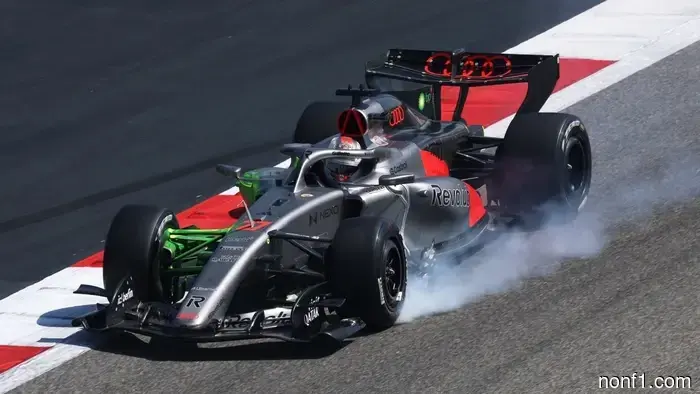
How Brembo Reengineered F1 Brakes for the 2026 Power Unit Transformation
Mark Thompson via Getty
The latest news and reviews in the automotive world, without the fluff.
Subscribe to our free daily newsletter that delivers the most significant stories directly to your inbox every weekday.
By the time you read this, the 2026 Formula 1 vehicles will have completed both practice sessions on Friday at the season-opening Australian Grand Prix. Unlike pre-season testing, their performance around the 3.29-mile Albert Park Circuit will actually have implications. Before any pole positions or race victories can be determined, there is one crucial updated component that every driver and team must first master: brakes.
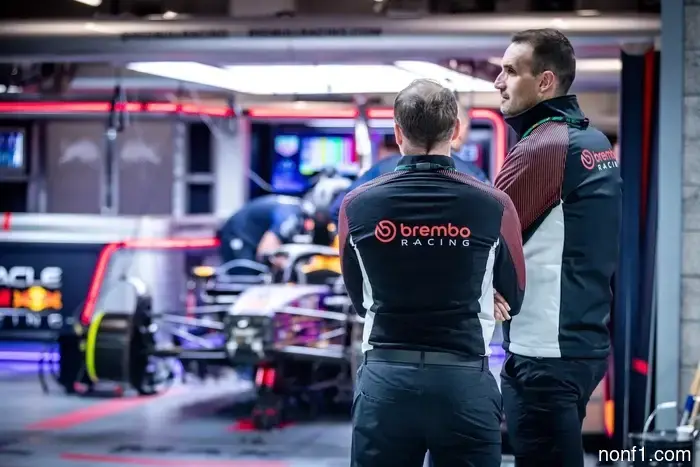
Under the Brembo Group's banner, both Brembo Brakes and AP Racing provide all F1 teams with braking components. For 2026, every one of the 11 teams will be using either Brembo or AP Racing calipers, while five teams are fitted with complete braking systems, including calipers, pads, and discs. Even those opting for calipers from one supplier but selecting different pads and discs may still use Brembo’s brake-by-wire systems and master cylinders. Consequently, Brembo engineers have faced a massive task in preparation for the 2026 season, working in collaboration with all the teams to adapt to the new regulations.
Brembo
I recently spoke with Andrea Algeri, an expert in braking systems. As the head of the open- and closed-wheel racing divisions for Brembo, he is responsible for understanding the regulatory changes and ensuring Brembo meets the teams' expectations and custom design requests. My initial question was about the specific regulatory changes. He provided a detailed explanation that lasted around 20 minutes.
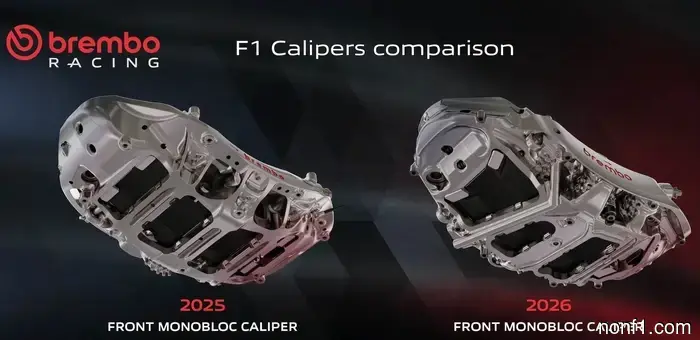
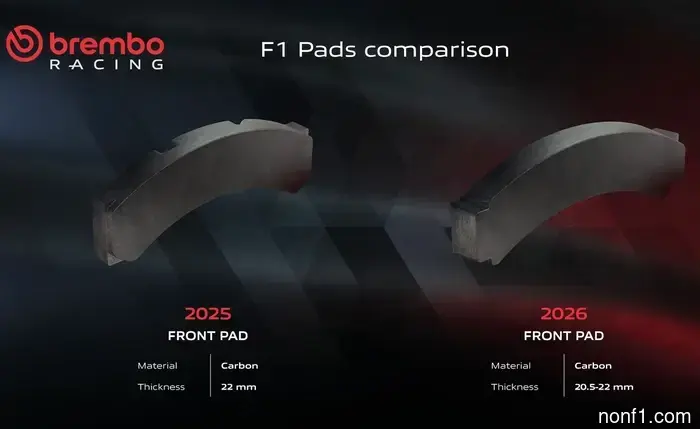
To simplify that information: The most significant alteration in braking is the broader range of design options for components, particularly calipers and discs. The front calipers continue to be aluminum monoblock, but teams can now choose between six- or eight-piston configurations. Previously, the six-piston setup was standard. However, teams that opt for more pistons must adhere to several changes in the core design of the caliper. For instance, increasing the piston count by two also expands the number of pads within the caliper from two to four. In addition, due to differences in the caliper housing, the number of fixing points increases from two to three. Surprisingly, the weight actually decreases by half a kilogram, or about 1.1 pounds, compared to the 2025 model. That’s significant.
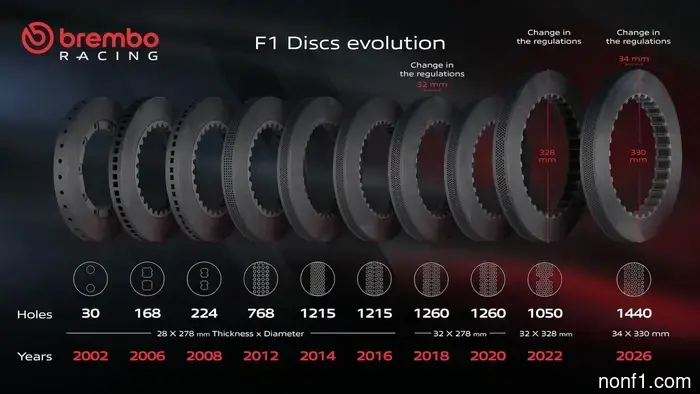
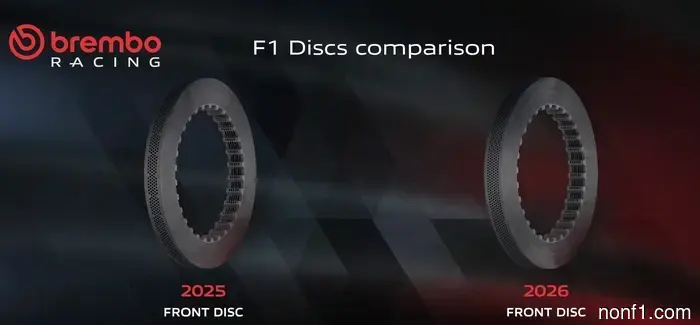
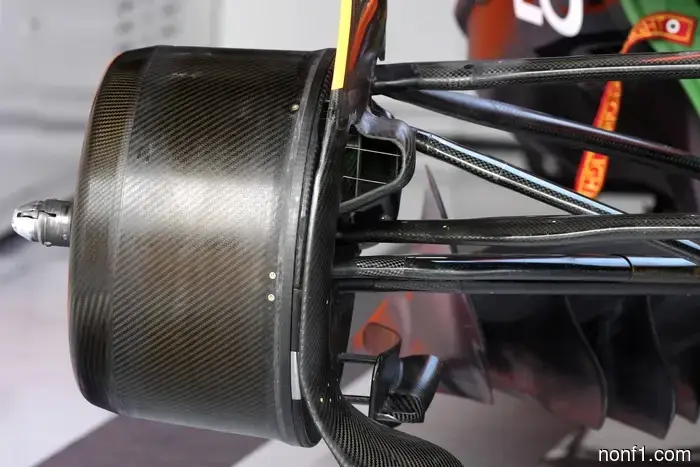
These changes apply only to the caliper; there are also updates to the disc, or rotor. For 2026, both the diameter and thickness of the disc as well as the number of venting holes have been increased. The diameter went from 328mm to 330mm, although teams can use discs up to 345mm based on their caliper choice. Disc thickness has increased for the first time since 2018, from 32mm to 34mm, though teams can still use a 32mm unit depending on their caliper application. The number of holes has dramatically risen from last year's design, increasing from 1,050 three-millimeter holes in a honeycomb pattern to 1,440 two-point-five millimeter venting holes arranged linearly. Disc weight has also gone up from 1.75 kilos to 2 kilos, totaling around 4.4 pounds at each corner.
Brembo
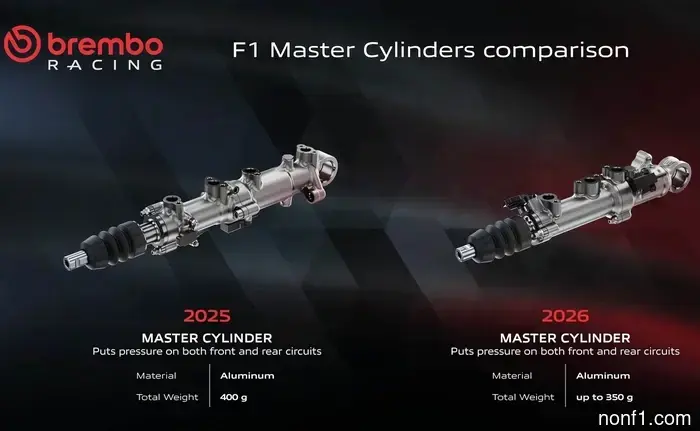
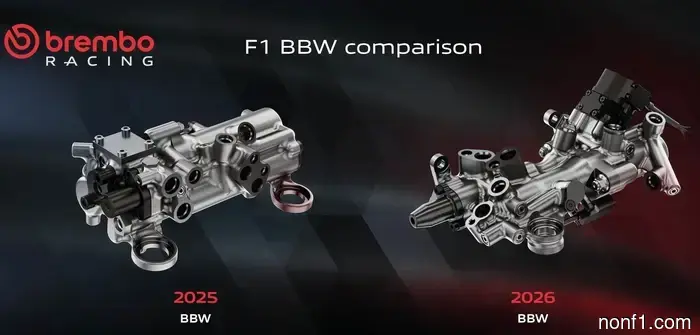
As Algeri further clarified, while the hardware changes are significant, another crucial challenge is the final integration of these components with each team's car. There is also the software aspect to consider. With Brembo supplying a completely redesigned hydraulic brake-by-wire system, new software is essential to synchronize braking performance with inputs from the driver, power unit, and hybrid system.
Once the hardware and software are seamlessly integrated, Brembo must collaborate with each team to optimize their setups for peak performance. In F1, no two teams have the same configurations, as each one believes it possesses a superior strategy. Although the regulations set the parameters, the implementation will not be uniform across all teams.
“Teams are always searching for an advantage, and we have to assist them in achieving their goals, but there is often a compromise,” Algeri shared with The Drive. “Our long experience has built mutual trust; if we have to agree or decline a request, they understand our reasoning. We also conduct all the necessary testing to provide data supporting our decisions.”
Brembo
When I inquired about the benefits of moving from the previous six-piston setup to an eight-piston caliper, Algeri indicated that while there are advantages, it ultimately depends on what best suits each team's configuration. An eight-piston system is mechanically more intricate and contains more moving parts, but it allows for more balanced braking pressure on the disc and increased initial torque. The enhanced clamping force is beneficial at the front wheels; however, the situation is entirely different at the back, where the hybrid power unit powers the tires.
This
Other articles
 Drivers have confidence in the FIA as the situation in Iran casts uncertainty over the F1 schedule.
Formula 1 | The drivers of Formula 1 express their confidence in the sport's leadership to make the best decisions amid the growing Iran crisis, which raises concerns about the Bahrain event and (…)
Drivers have confidence in the FIA as the situation in Iran casts uncertainty over the F1 schedule.
Formula 1 | The drivers of Formula 1 express their confidence in the sport's leadership to make the best decisions amid the growing Iran crisis, which raises concerns about the Bahrain event and (…)
 Production of the Audi A8 is concluding after 32 years, with no successor planned.
Audi has halted orders for its flagship sedan in Germany, with other countries set to follow suit shortly.
Production of the Audi A8 is concluding after 32 years, with no successor planned.
Audi has halted orders for its flagship sedan in Germany, with other countries set to follow suit shortly.
 Glock suggests that a separation between Aston and Honda is still a possibility.
Formula 1 | Former F1 driver Timo Glock has stated that the prospect of Aston Martin ending its Honda works agreement during the season cannot be excluded, as the (…)
Glock suggests that a separation between Aston and Honda is still a possibility.
Formula 1 | Former F1 driver Timo Glock has stated that the prospect of Aston Martin ending its Honda works agreement during the season cannot be excluded, as the (…)
 Schumacher cautions about television errors as the complexity of F1 increases.
Formula 1 | Ralf Schumacher has cautioned that even the television analysts of Formula 1 will find it challenging to grasp the intricacies of the 2026 regulations, (…)
Schumacher cautions about television errors as the complexity of F1 increases.
Formula 1 | Ralf Schumacher has cautioned that even the television analysts of Formula 1 will find it challenging to grasp the intricacies of the 2026 regulations, (…)
 The production of the Audi A8 is coming to an end after 32 years, with no successor on the horizon.
Audi has stopped accepting orders for its flagship sedan in Germany, and other countries will soon follow suit.
The production of the Audi A8 is coming to an end after 32 years, with no successor on the horizon.
Audi has stopped accepting orders for its flagship sedan in Germany, and other countries will soon follow suit.
 Leclerc discusses his 'marriage' with Ferrari and cautions that Mercedes appears to be in good shape.
Formula 1 | Charles Leclerc has candidly addressed the possibility of extending his contract with Ferrari - but on the track, he cautioned that Mercedes appears to be considerably stronger than (…)
Leclerc discusses his 'marriage' with Ferrari and cautions that Mercedes appears to be in good shape.
Formula 1 | Charles Leclerc has candidly addressed the possibility of extending his contract with Ferrari - but on the track, he cautioned that Mercedes appears to be considerably stronger than (…)
How Brembo Reengineered F1 Brakes for the 2026 Power Unit Transformation
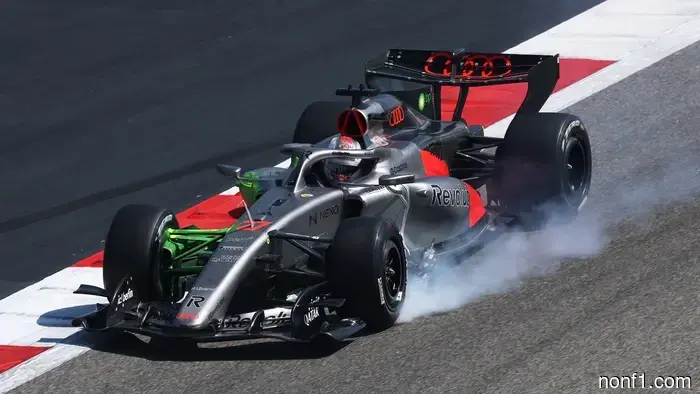
Curious about why everyone in Australia is losing control and going off course? Here’s what you need to understand about the brakes and their impact on F1 cars.