
Technical innovations presented by the teams in Miami
Rarely does the list of technical innovations prepared by a team for an upcoming race fit on a single page of the official FIA report, but this is exactly the case now. However, this was to be expected, as many participants in the World Championship timed the first stage of modernization of their new cars to the Miami Grand Prix.
McLaren
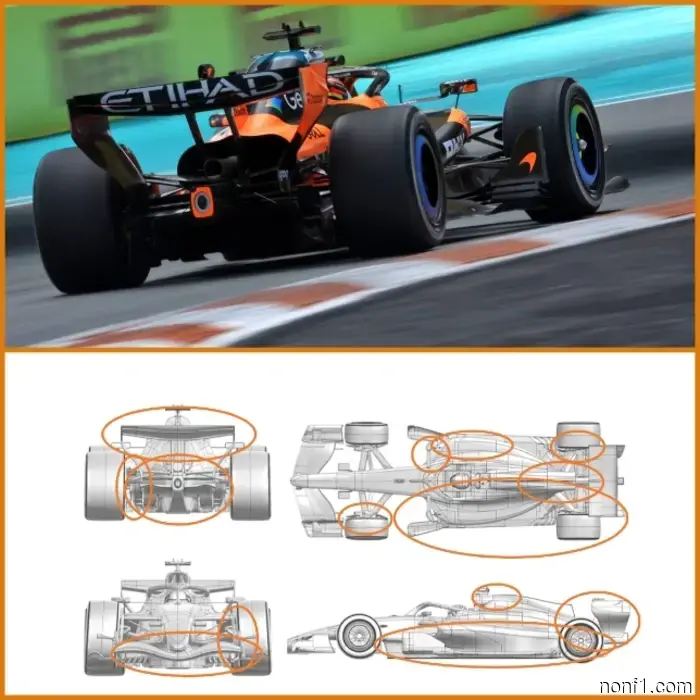
The team from Woking presented a list of seven items, the first of which is dedicated to the "front corner" of the chassis – a term commonly used in Formula 1. McLaren does not specify what and how has changed, simply stating that elements in this area of the MCL40 have been revised to improve their interaction with the front wing and achieve optimal airflow effects.
Next, it mentions that changes have affected the engine cover and other body components located in the central area of the car, which has also improved flow characteristics and achieved some local increases in downforce.
The geometry of the side pod air intakes and rearview mirror mounts has been revised – this was done to improve the interaction of these elements with the updated floor of the car.
Considering the characteristics of the Miami track, where maximum cooling efficiency of the power unit is required, additional louvres have appeared on the side pods.
As mentioned, the MCL40 has received a new floor, which should allow for increased downforce on any track and in any conditions. The elements of the "rear corner" of the chassis have also been revised in accordance with the updated geometry of the floor.
The rear wing has been updated – it now features additional elements, and the geometry of the end plates has been changed, which has improved overall efficiency.
Mercedes
Judging by the fact that the list of innovations presented by Mercedes contains only two items, the team leading the championship is doing quite well.
Firstly, the position of the central exhaust pipe has been slightly adjusted – it is now positioned lower, i.e., further from the rear wing, and a specially designed bracket has been added to it. All of this together reduces airflow resistance in this area of the car and achieves some increase in downforce.
Secondly, the geometry of the front brake ducts has been revised, which has allowed for "reducing local efficiency losses and improving flow parameters directed towards the rear of the car, thereby increasing downforce."
Red Bull Racing
The RB22 has an updated front wing, including changes to the geometry of the end plates. The aim of the changes is to increase downforce and flow stability.
Also, in the front area of the car, the "configuration of the surfaces of body components" located around the front wheels has been revised. The efficiency of the front brake ducts has been improved.
The configuration of the side pod air intakes, the geometry of the rearview mirror mounts, and the surfaces of body components adjacent to this area have been changed in accordance with the modifications made to the floor and engine cover.
The louvres of the cooling system, through which hot air exits, have been changed at the top of the cover.
The floor of the car has been modernized, with changes made to its front area and edges, allowing for increased downforce while maintaining the previous level of stability.
In the rear corner of the car, the geometry of the body components and fairings of the suspension elements has been revised, and the brake ducts have been optimized.
The mechanism that activates the movable element when the straight-line mode is engaged has been changed on the rear wing.
Ferrari
The list of improvements presented by the Italian team contains a record 11 items, starting with an updated front wing, various elements of which have been redesigned to enhance the stability of the airflow around the car as a whole. Additionally, the front deflector has been modernized.
The profile of the fairings of the triangular arms of the front suspension has been changed, which helps to optimally redistribute aerodynamic load between the upper and lower arms and other suspension elements.
The SF-26 floor has been updated, with changes affecting both its central part and edges. New vertical elements have appeared on the floor, and the geometry of the front area and additional elements located on it has changed.
The rear part of the floor interacts with its front part and the diffuser, all aimed at increasing downforce in any conditions.
The profile of the diffuser elements has been changed, including the redesign of additional elements located at its rear edges, where a new vertical deflector has appeared. Additionally, the profile of the fairings of the rear suspension's traction elements has also changed.
On the rear wing, the profile of both planes – the main and the movable – has been altered; the attachment of the main plane to the pylon has been modified, and the geometry of the upper part of the end plates has been revised.
Williams
Williams is one of those teams that is making every effort to improve the efficiency of a chassis that turned out to be too heavy at the start of the season. The FW48 has received an updated floor, and as the team explains, its thickness has been changed in certain places, and the geometry of the edges and various elements located in the front and central parts has been revised. It is also reported that all of this contributes to improving its stable performance across a wide range of settings and conditions.
The geometry of the side pod air intakes has been changed, affecting its outer surfaces, which serves to enhance the efficiency of the cooling system and achieve better airflow characteristics.
The configuration of the cooling system louvres on the engine cover has been revised, and the overall updated geometry of the cover helps stabilize the flow in the rear area of the car.
The shape and design of the rearview mirror housing have changed, and the position of the mirror has also become somewhat different. These measures ensure better airflow characteristics around the cockpit, directing it downwards and along the sides of the chassis.
The attachment of the rear end of the exhaust pipe and the fairings surrounding the rear structure that absorb impact energy have been modified, contributing to flow stabilization. The lower elements of the rear wing attachment have also been revised to improve the interaction of the flow with other aerodynamic components located in this area of the car.
Racing Bulls
The team from Faenza is trying to keep up with Red Bull Racing, and the VCARB 03 also has several innovations. In its rear corner, the brake ducts have been modernized, and the profile of the rear suspension arms has been changed to optimize the flow around the tires.
The geometry of the rear part of the floor has been revised, both planes of the rear wing have been updated, as well as the end plates – for more effective interaction with other wing elements.
The front wing has also undergone certain modifications, but in this case, it concerns the geometry of the movable element, which has become narrower in accordance with the characteristics of the Miami track.
Haas F1
On the cars of Oliver Berman and Esteban Ocon, there is a single change – an additional wing has appeared on the diffuser to increase downforce in this specific area and optimize aerodynamic pressure redistribution.
Audi F1
The Audi R26 has new front brake ducts, modernized fairings of the front suspension elements, and the shape of the edges of the floor and diffuser has been changed in the rear part of the car.
Alpine F1
The list of updates reported by the Renault factory team is quite extensive. In particular, it mentions front brake ducts redesigned to improve flow quality in the front area of the car, and even the mounts for the camera installed on the nose fairing have been changed.
In the rear part of the A526, the profile of the suspension arms has been revised, the geometry of the rear impact structure elements has been adjusted, and the rear wing has been completely redesigned, contributing to improved aerodynamic efficiency overall. In accordance with these modifications, the geometry of the end plates has also changed.
Cadillac F1
The new American team has also prepared a whole range of innovations for its home race. The MAC26 has had its front wing elements redesigned, including its end plates and movable element, which has received a different profile.
The mounts for the rearview mirrors have been redesigned, positively affecting the flow directed towards the rear of the car and increasing the strength of the entire structure.
The floor has been modernized, with changes made to the geometry of the front part and the additional aerodynamic elements installed on it. This, in turn, allows for improved efficiency of the rear part of the floor and diffuser. Certain changes have also occurred in the floor area in front of the rear wheels, and the diffuser has been redesigned to work more effectively with changes in ride height at the rear of the car.
Additionally, the position of the rear end of the exhaust pipe and its design have been changed, also aimed at increasing aerodynamic load in the rear part of the car.
Other articles
 Andrea Stella: Our new products are working!
McLaren team principal Andrea Stella is pleased with the results of the sprint qualifying and Lando Norris's first place...
Andrea Stella: Our new products are working!
McLaren team principal Andrea Stella is pleased with the results of the sprint qualifying and Lando Norris's first place...
 Mekis: Lambyaz will become the team leader of McLaren.
Red Bull Racing team principal Laurent Mekies said that Gianpiero Lambias will head the McLaren team.
Mekis: Lambyaz will become the team leader of McLaren.
Red Bull Racing team principal Laurent Mekies said that Gianpiero Lambias will head the McLaren team.
 Formula 2: The qualification in Miami was won by Kush Maini.
For the first time in the history of both Formula 2 and the Miami Grand Prix, the youth series races are taking place on a track laid out around the Hard Rock Stadium complex, and this fact alone promises increased interest in the event...
Formula 2: The qualification in Miami was won by Kush Maini.
For the first time in the history of both Formula 2 and the Miami Grand Prix, the youth series races are taking place on a track laid out around the Hard Rock Stadium complex, and this fact alone promises increased interest in the event...
 Sergio Perez showed the helmet design for the Miami Grand Prix.
Less than an hour before the start of the only free practice session of the Miami Grand Prix, Sergio Perez posted a photo on social media of the racing helmet he will be wearing this weekend.
Sergio Perez showed the helmet design for the Miami Grand Prix.
Less than an hour before the start of the only free practice session of the Miami Grand Prix, Sergio Perez posted a photo on social media of the racing helmet he will be wearing this weekend.
 The atmosphere in Miami already resembles the Super Bowl.
Just a month ago, the traditional Miami Open tournament took place at Hard Rock Stadium, and in the middle of the stadium were courts where the stars of world tennis competed, and now the Miami Grand Prix paddock is located here...
The atmosphere in Miami already resembles the Super Bowl.
Just a month ago, the traditional Miami Open tournament took place at Hard Rock Stadium, and in the middle of the stadium were courts where the stars of world tennis competed, and now the Miami Grand Prix paddock is located here...
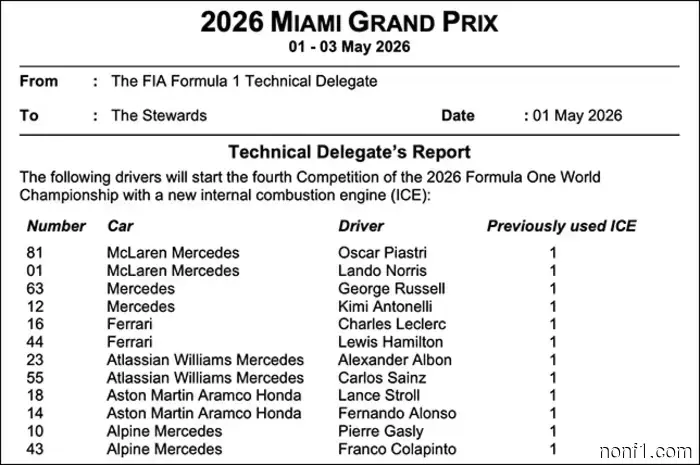 On 16 machines, the power unit components were replaced.
The FIA confirmed the replacement of power unit components on 16 cars...
On 16 machines, the power unit components were replaced.
The FIA confirmed the replacement of power unit components on 16 cars...
Technical innovations presented by the teams in Miami
Rarely does the list of technical innovations prepared by a particular team for the next race fit on a single page of the official FIA report, but this is exactly such a case. However, this could have been expected...