
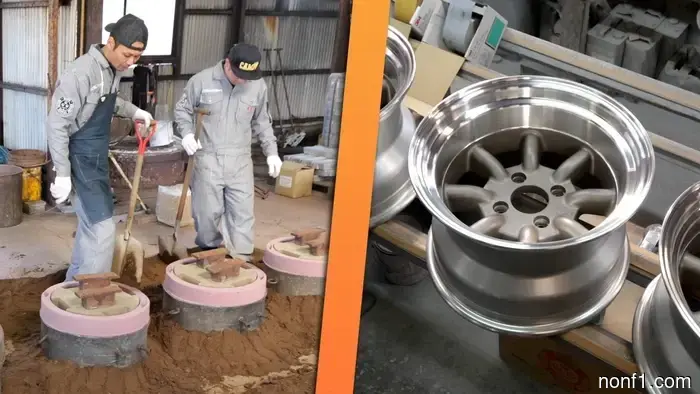
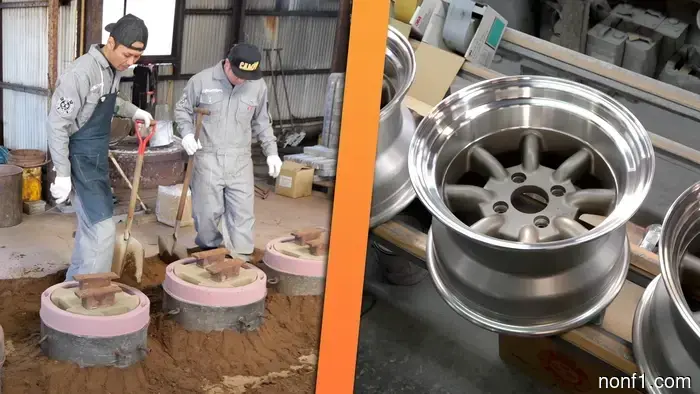
Discover the Craftsmanship Behind Watanabe Wheels: Handmade in Japan with Traditional Techniques.
Japanese Industry Process via YouTube
The latest news and reviews in the automotive world, without any fluff.
Subscribe to our free daily newsletter to receive the most significant stories directly in your inbox every weekday.
Over the years, Japan has been known for many iconic wheel designs, but few have reached the level of desirability as those crafted by Racing Service Watanabe. RS Watanbes and a Hakosuka Skyline GT-R are a classic pairing, akin to sushi and wasabi, and the fact that these wheels are still made by hand limits their availability. Currently, there’s a two-year wait for them.
Fortunately, there is now an in-depth video that showcases the manufacturing process of these legendary wheels. The video, produced by the aptly named Japanese Industry Process YouTube channel, runs for about 50 minutes and covers each step involved in creating both aluminum and magnesium wheels. The process begins with melting the metal—including leftover scraps—to pour into molds for casting the wheels. This occurs in compact furnaces located directly on the shop floor, surrounded by piles of molds and tools. While Japan houses many expansive, advanced factories, this isn't one of them.
The aluminum is heated to a temperature of 1,292 degrees Fahrenheit. It is then scooped from the furnaces into buckets lined with graphite for heat resistance. At this stage, the mold pieces are also heated, dust is blown away with air, and a release agent is applied to stop the material from sticking to the mold. Each mold has two halves along with a central core that mirrors the wheel's hub and spokes. These sections are clamped together before the molten aluminum is poured in and allowed to cool under pressure.
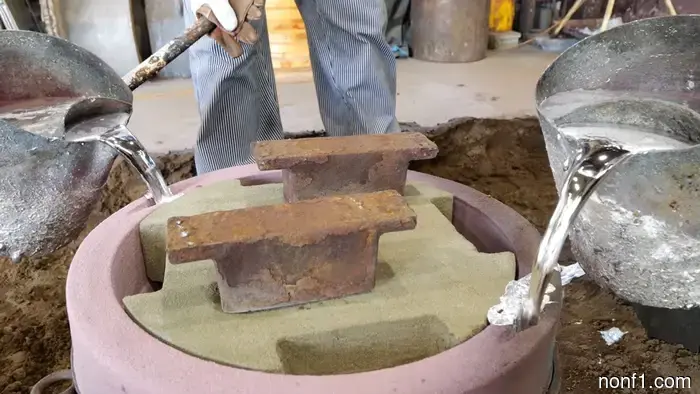
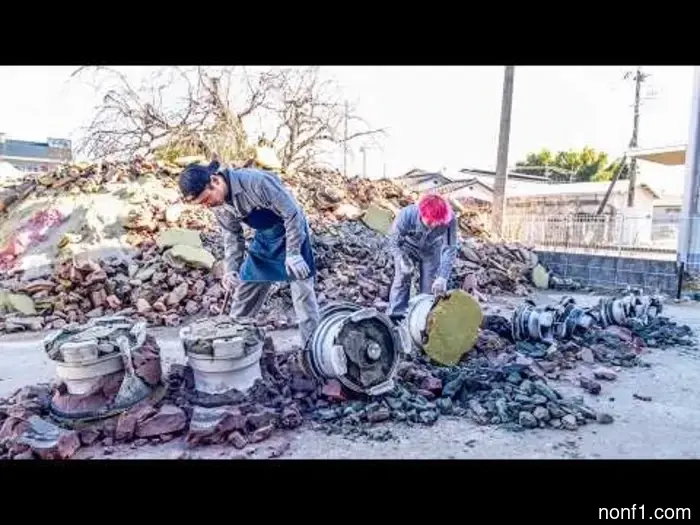
Watanabe constructs magnesium wheels using a more traditional sand casting method. The molds are created from compacted sand that must be carefully heated and dried to ensure maximum strength and eliminate moisture, as it could react violently with magnesium. The molds are placed in sand piles, the material is poured in, and then the mold is chipped away to release the wheel.
When the wheels emerge from the mold, they are far from ready for installation. Excess aluminum is either hammered or sawed off, surfaces are sanded smooth, and any dents are repaired by adding more material with a TIG welder before being ground down for a smooth finish. Some finishing work is performed using a CNC machine—creating a notable contrast with the otherwise traditional appearance of the workshop—but stud holes are still drilled manually. Finally, the wheels receive a gray paint coat before being packaged and shipped.
It seems appropriate that classic wheels like these are produced using a traditional process. Witnessing raw metal transform into one of the most recognizable aftermarket wheel designs is quite fascinating.
Other articles
 Danner: With age, a racer inevitably loses something.
The average age of the top three finishers in the Miami Grand Prix is 23 years, 8 months, and 28 days. Meanwhile, Lewis Hamilton is already over forty, and discussions about his inevitable retirement continue...
Danner: With age, a racer inevitably loses something.
The average age of the top three finishers in the Miami Grand Prix is 23 years, 8 months, and 28 days. Meanwhile, Lewis Hamilton is already over forty, and discussions about his inevitable retirement continue...
 WEC: First victory and double success for BMW
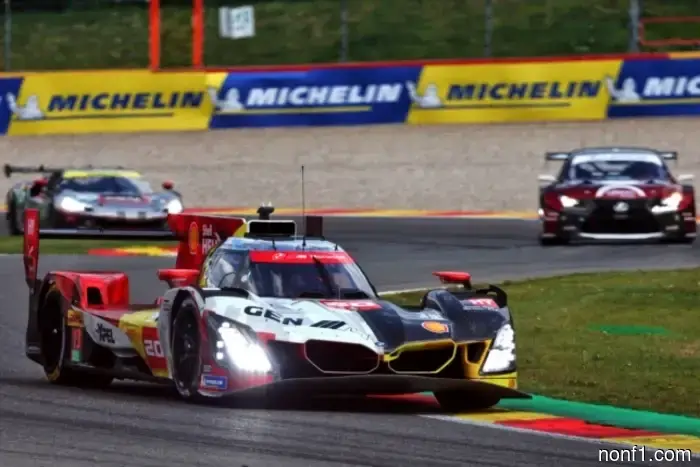
The BMW factory team achieved its first victory in the Hypercar category, and this is not just a win, but a winning double in the "6 Hours of Spa"...
WEC: First victory and double success for BMW
The BMW factory team achieved its first victory in the Hypercar category, and this is not just a win, but a winning double in the "6 Hours of Spa"...
 Andrea Stella: The Mercedes car is still faster
Andrea Stella identified a critically important area where Mercedes still has an advantage over McLaren...
Andrea Stella: The Mercedes car is still faster
Andrea Stella identified a critically important area where Mercedes still has an advantage over McLaren...
 IndyCar: Christian Lundgaard secured victory for McLaren
Christian Lundgaard, a former member of the Renault/Alpine academy, whom we remember from Formula 2, is now competing for McLaren in IndyCar and recently achieved his second victory in the American series...
IndyCar: Christian Lundgaard secured victory for McLaren
Christian Lundgaard, a former member of the Renault/Alpine academy, whom we remember from Formula 2, is now competing for McLaren in IndyCar and recently achieved his second victory in the American series...
 Hadjar: I enjoy everything that is happening at Paul Ricard.
This weekend, 25,000 spectators gathered in the stands of the Paul Ricard circuit in Le Castellet, eagerly watched what was happening on its track, as the traditional Historic Grand Prix of France was taking place there...
Hadjar: I enjoy everything that is happening at Paul Ricard.
This weekend, 25,000 spectators gathered in the stands of the Paul Ricard circuit in Le Castellet, eagerly watched what was happening on its track, as the traditional Historic Grand Prix of France was taking place there...
 Volvo's Chief Commercial Officer understands that charging for heated seat subscriptions is simply another method to 'nickel and dime' customers.
According to Volvo's Eric Severinson, customers who spend $80,000 on a new car shouldn't be required to pay monthly fees for heated seats.
Volvo's Chief Commercial Officer understands that charging for heated seat subscriptions is simply another method to 'nickel and dime' customers.
According to Volvo's Eric Severinson, customers who spend $80,000 on a new car shouldn't be required to pay monthly fees for heated seats.
Discover the Craftsmanship Behind Watanabe Wheels: Handmade in Japan with Traditional Techniques.
From casting molten metal into compacted sand molds on the ground to the polishing stage, this is truly an impressive sight.