

Tombasis on the goals and methodology of measurements in the ADUO program
In an interview with SoyMotor, FIA's Director of Single-Seater Racing, Nicholas Tombazis, once again explained the principle of the ADUO program (Additional Development and Upgrade Opportunities), designed to support power unit manufacturers.
Nicholas Tombazis: "Negotiations on these regulations began about five years ago. Significant efforts were made at that time to attract new names to Formula 1, but there was concern that newcomers would always lag behind more experienced manufacturers.
With the introduction of budget caps, there was a feeling that if you start to fall behind... Previously, when you fell behind, you spent a lot of money and eventually caught up, as Honda did in 2017. With a budget cap, your opportunities are severely limited. There was concern that if you start to fall behind, you would be left behind forever, which would lead to those manufacturers leaving the sport. That’s when the ADUO concept emerged.
It then became clear that the main battle would unfold over the electric component of the power unit, as electric motors were often considered the technology of the future at that time. In 2021, many said they would never produce internal combustion engines again. Ultimately, that turned out to be a mistake.
In response, we said, 'If you think the only thing that matters is electricity, let’s make a standard internal combustion engine, and with the electric part, we’ll give you complete freedom.' But they didn’t want that either.
It was believed that the competition in the internal combustion engine segment would not be as fierce, so if you were lagging, you should have the time, money, and resources to catch up. This fundamental philosophy prompted ADUO to focus exclusively on internal combustion engines.
At the beginning of 2025, there was much discussion about how to measure this, then details and secondary parameters were clarified. For example, if the intake manifold temperature of the engine is very high, it will have less power but will require less cooling, and therefore the car's aerodynamics will be better, even though the engine's efficiency will decrease. Should this temperature be considered in the ADUO calculation? This was discussed. There were other parameters affecting engine performance.
During these discussions, the position of the engine manufacturers came down to simplifying the task and focusing solely on power. We agreed, adopting a position of maximum simplification, even though we could have used a more complex formula.
It was decided that the primary method of measurement would be the use of a certified torque sensor. Essentially, it is located between the engine and the gearbox. A correction is then applied to exclude the known electric component.
Thus, we obtain the output power of each car on each lap. We then take data from all cars on each lap and apply statistical analysis to exclude slow laps when they are behind the safety car or in VSC mode. We average this data to obtain the output power of each car, select the most representative data for each manufacturer, and thus obtain the difference between the best and worst, which is compiled into a table and becomes the basis for granting development permissions."
Tombazis had previously spoken about the methodology for permissions and the volumes of upgrades...
Other articles
 Jack Crawford will replace Stroll in training in Austria.
The Aston Martin team has confirmed that reserve driver Jack Crawford will take part in the first Friday practice in Austria and will drive Lance Stroll's car at the Red Bull Ring circuit...
Jack Crawford will replace Stroll in training in Austria.
The Aston Martin team has confirmed that reserve driver Jack Crawford will take part in the first Friday practice in Austria and will drive Lance Stroll's car at the Red Bull Ring circuit...
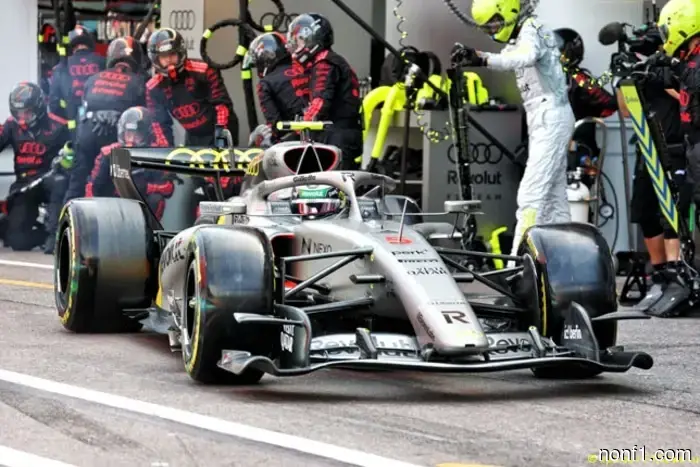 Bortoleto: The Audi engine is a second slower per lap.
In this season, the Audi team has only two points, earned by Gabriel Bortoleto in the first round of the season in Melbourne. The Brazilian driver stated that the main problem lies in the power unit, which causes the team to lose a second per lap.
Bortoleto: The Audi engine is a second slower per lap.
In this season, the Audi team has only two points, earned by Gabriel Bortoleto in the first round of the season in Melbourne. The Brazilian driver stated that the main problem lies in the power unit, which causes the team to lose a second per lap.
Tombasis on the goals and methodology of measurements in the ADUO program
Nicholas Tombasis explained once again the principle of the ADUO program, developed to support power plant manufacturers.