
Hungarian Grand Prix: Track and Statistics
FORMULA 1 AWS HUNGARIAN GRAND PRIX 2026
Date
Circuit
Lap length
Laps
Distance
24-26/08/2026
Hungaroring
4381 m
70
306.630 km
Official website
Formula 1 debuted in Hungary in 1986, but this stage could have taken place in the USSR. Bernie Ecclestone wanted to hold a race behind the "Iron Curtain," considering the Soviet Union, China, and Yugoslavia as candidates. Feeling the strength of this "curtain" and the bureaucratic complexities, Ecclestone settled on Hungary. Tamás Frank became the promoter of the stage – he and Bernie were friends for many years until Tamás passed away in the summer of 2012. On September 10, 1985, a contract was signed, construction began three weeks later, and on August 10, 1986, the debut stage of Formula 1 took place at Hungaroring. "Tamás was a man of action, very straightforward and sincere. Despite the small budget that the organizers had at the time, he did an excellent job. I am proud that I started holding this race in 1986 when Hungary was still behind the 'Iron Curtain,'" Ecclestone stated a few years ago. Today, the Hungarian stage can confidently be called historic; Hungaroring is the oldest circuit on this season's calendar, built specifically for Formula 1. It is one of the few circuits that has always been present on the calendar since its opening. The current contract is valid until 2037. For the 2025 stage, the paddock was renovated, and new asphalt was laid – the old circuit is now almost like new.
Circuit features
In terms of average speed, Hungaroring is surpassed only by Monaco; it is a very slow circuit where it is not easy to find the right setup and difficult to overtake. Cars are set up for maximum downforce, and the aerodynamic settings are similar to those used in Barcelona or Monaco. The suspension must be soft enough to ensure stable contact with the track. It is extremely important to make the tires work while avoiding overheating issues – usually, the Hungarian weekend takes place in hot weather. Twelve out of 14 corners are taken at speeds around 200 km/h. Engine power and energy distribution are not as important here as they are in Silverstone and Spa, where the last two stages took place. At the same time, the physical conditioning requirements for drivers are high, as they are almost always in braking zones and corners, with the opportunity to catch their breath only on the main straight. Braking is not too strong, but brake wear is high because they do not have time to cool down. Hungaroring is not used for racing very often, so on Friday, the track condition leaves much to be desired, and Saturday's practice is more suitable for working with tires. It is important to start well at Hungaroring, as the peloton stretches in the slow second and third corners. The straight before the first corner is quite long – 400 meters from pole to braking point. Diego Ioverno, sports director of Ferrari: "We have been racing at Hungaroring for forty years. The stage takes place in the height of summer; it is usually hot on the track, but there can also be unexpected downpours. The circuit is slow, just like Monaco and Singapore. Overtaking is difficult; cars are set up for high downforce, considering the large number of slow corners. Although overtaking is not easy, one pit stop is usually not enough. From a weather perspective, the stage in Hungary is challenging. There are few straights where radiators can cool the power unit, gearbox oil, brakes, and other components. Although maximum power is not very important on this track, so heating is not too strong, this factor still needs to be considered. On Friday, it is important to choose the optimal cooling level that will ensure reliability and speed. We will correlate real data with calculations obtained from the simulator. Tire temperature control is also very important."
Best session results of the Hungarian Grand Prix 2025
Event
Weather
Driver
Team
Time
First practice
Sunny. Dry
L.Norris
McLaren
1:16.052
Second practice
Sunny. Dry
L.Norris
McLaren
1:15.624
Third practice
Sunny. Dry
O.Piastri
McLaren
1:14.916
Qualifying
Cloudy. Dry
C.Leclerc
Ferrari
1:15.372
Best lap in the race
Cloudy. Dry
G.Russell
Mercedes
1:19.409
Weekend schedule
You can follow all Formula 1 sessions on our live broadcast page.
Hungarian Grand Prix schedule. Moscow time
Day
Event
Time
24/07
Formula 3. First practice
10:55 - 11:40
24/07
Formula 2. First practice
12:05 - 12:50
24/07
Formula 1. Car presentation
13:00 - 14:00
24/07
Formula 1. First practice
14:30 - 15:30
24/07
Formula 3. Qualifying
16:00 - 16:30
24/07
Formula 2. Qualifying
17:05 - 17:35
24/07
Formula 1. Second practice
18:00 - 19:00
25/07
Formula 3. Sprint (19 laps or 40 minutes + 1 lap)
11:05 - 11:50
25/07
Formula 1. Third practice
13:30 - 14:30
25/07
Formula 2. Sprint (28 laps or 45 minutes + 1 lap)
15:15 - 16:05
25/07
Formula 1. Qualifying
17:00 - 18:00
26/07
Formula 3. Race (24 laps or 45 minutes + 1 lap)
09:40 - 10:30
26/07
Formula 2. Race (37 laps or 60 minutes + 1 lap)
12:25 - 13:30
26/07
Formula 1. Drivers' parade
14:00 - 14:30
26/07
Formula 1. Hungarian Grand Prix (70 laps or 120 minutes)
16:00 - 18:00
Tire sets issued to teams for the weekend
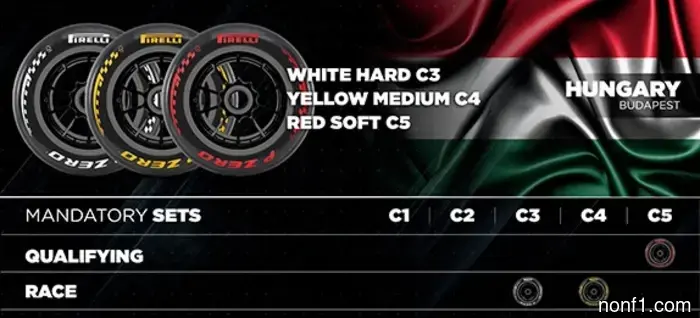
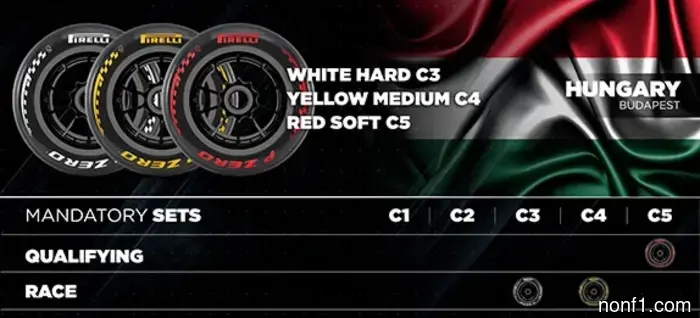
The short and winding Hungarian circuit (4.381 km and 14 corners) is often compared to a karting track. There is only one real straight – the start-finish, where overtaking is possible; the rest of the lap, drivers are in corners, including 180-degree ones – because of this, car setups are usually very similar to those used in Monaco. Like in the Principality, in Budapest, teams will receive the three softest compounds – C3, C4, and C5. This is the best choice for a slow track where grip and stability under braking are very important due to constant direction changes. The asphalt surface has pronounced roughness due to wear on sections that have not been updated, and very low grip, which improves throughout the weekend. The asphalt temperature at Hungaroring is one of the highest during the season; one of the main factors affecting tire performance, especially on the rear axle due to constant accelerations, will be thermal degradation. Granulation may occur on the softer compounds. It is expected that due to tire degradation, the time difference between completing the distance with one and two pit stops will be small, but track position, where overtaking is very difficult, may influence the choice of strategy. At very high asphalt temperatures, teams will likely prefer the two hardest compounds.
Achievements of current drivers in Hungary
Despite the difficulties with overtaking, only 16 out of 40 Hungarian Grand Prix races have been won by pole sitters. Lewis Hamilton is the absolute leader in the number of victories at the Hungarian circuit – he has stood on the top step of the podium eight times. The lowest starting position of a Hungarian Grand Prix winner is 14th place by Jenson Button in the rainy race of 2006 – this was the British driver's first career victory.
Achievements of current drivers at the Hungarian Grand Prix
Driver
GP
Points
Laps
Best
pole
1st row
fast
lap
podium
victory
all
leader
start
finish
F.Alonso
22
153
1427
143
1
1
Other articles
 Lewis Hamilton was the fastest in the second practice.
Hamilton topped the second practice protocol, completing a lap in 1:18.729...
Lewis Hamilton was the fastest in the second practice.
Hamilton topped the second practice protocol, completing a lap in 1:18.729...
 Alex Albon: The conditions were challenging on Friday.
On Friday at the Hungaroring, the Williams drivers took their usual positions – the car did not allow for more…
Alex Albon: The conditions were challenging on Friday.
On Friday at the Hungaroring, the Williams drivers took their usual positions – the car did not allow for more…
 Nico Hülkenberg: Every little detail will matter
Audi worked without any issues on Friday, completing the planned program...
Nico Hülkenberg: Every little detail will matter
Audi worked without any issues on Friday, completing the planned program...
 Photo gallery: 24/07. Hungarian Grand Prix, Friday
© F1News.Ru Editorial 1997-2026. Media registration certificate El No. FS77-29173. Registered with the Federal Service for Supervision of Communications, Information Technology and Mass Communications.
Photo gallery: 24/07. Hungarian Grand Prix, Friday
© F1News.Ru Editorial 1997-2026. Media registration certificate El No. FS77-29173. Registered with the Federal Service for Supervision of Communications, Information Technology and Mass Communications.
 Lewis Hamilton was the fastest in the second practice.
Hamilton topped the second practice session, completing a lap in 1:18.729...
Lewis Hamilton was the fastest in the second practice.
Hamilton topped the second practice session, completing a lap in 1:18.729...
 Bortoleto: I have a long-term contract with Audi.
In response to the question about the contract for the next season, Gabriel Bortoleto dispelled any doubts – he will remain with Audi…
Bortoleto: I have a long-term contract with Audi.
In response to the question about the contract for the next season, Gabriel Bortoleto dispelled any doubts – he will remain with Audi…
Hungarian Grand Prix: Track and Statistics
By average speed, Hungaroring is surpassed only by Monaco; it is difficult to find setups on this track and challenging to overtake...