

Is your car able to fit in your garage?
Byron Hurd
The most important car news and reviews, no nonsense.
Our free daily newsletter delivers the significant stories directly to you every weekday.
If you're a car lover with your own garage to call home, it's likely you're actually using it to store a vehicle. At least, that seems to be the case based on a quick and entirely unscientific survey of my close friends and colleagues. However, general public surveys suggest that only about one-third of people with garages actually utilize them for cars. This apparently makes us the odd ones out, but the logical follow-up question is: Why?
The answer is twofold. The first part is quite simple. Over the past 30 years, it's become clear that cars and trucks are increasing in size while garages are decreasing. Ironically, one of the most quintessentially American aspects of the modern household is actually shrinking—particularly in new developments in sought-after suburban areas, where property values are high and lots are being subdivided to maximize single-family housing.
To provide some context, a typical F-150 (specifically, a SuperCrew with a 5′-5″ bed) measures 230 inches in length, which is just over 19 feet. This implies that it can barely fit into a garage that's about 20 feet deep, assuming full clearance is available. However, unless you're unconcerned about your bumpers or drywall, most people would prefer a garage that is at least 22 feet deep. Even then, closing the garage door means you’re not able to walk around either end of the truck. Remarkably, 22 feet is actually less than the average depth of many attached garages across the country, where the common size is 20’x20’.
That depth is sufficient for parking a typical compact crossover (like the Honda CR-V or Toyota RAV4) with enough room to walk around it. Even a mid-size truck would consume that space, as the shortest Toyota Tacoma available is still nearly 18 feet long.
So what is causing this discrepancy? It primarily comes down to financial considerations. Real estate near urban centers is increasingly valuable, and local building codes often hinder the simple solution of expanding a home's footprint. Instead, builders sacrifice garage space to create more livable square footage. To complicate matters further, these attached garages frequently require steps up to the main house, which can further diminish the usable interior space. What may appear as 20 feet on paper can often translate to just 17 or even 16 feet in reality.
At the same time, the areas once used for seasonal or bulk item storage are rapidly disappearing—not always to create more livable space but due to modern construction practices. Traditional, high-pitched roofs have largely gone out of style, supplanted by low-pitched colonial-revival and ranch-style roofs that severely restrict attic configurations. Additionally, contemporary roof trusses are predominantly designed to support just the roof above, the drywall below, and the insulation in between, making them inadequate for bearing any attic load. When you factor in the rising popularity of slab-on-grade construction rather than traditional basements, the result is a storage dilemma.
My garage when we moved in four years ago, and how it looks today. Even I am not exempt from the ongoing issue of "stuff." Byron Hurd
So where does all the clutter end up? You guessed it—right in the garage. As illustrated in the images above, I too am not immune to the accumulation of items. Living in a 1920s house (with a garage from the 1940s) in an urban neighborhood, our attic and knee walls are both sealed, and since our basement was built before they were expected to be consistently water-tight, our "stuff" ends up in and above the garage as well. We’re planning to address this by constructing a new, larger garage—but one that won't be any deeper.
Why? Well, in an area where code officials have significant authority, we’re restricted to a maximum of 800 square feet. Most three-car garages built within that size typically measure 32’x25’—just adequate enough for a relatively large pickup truck. But if you’re like me and prefer low-slung, two-door coupes and roadsters, the idea of having less than 10 feet per bay can be off-putting, especially since the space is further reduced by the garage walls. So, I opted for a wider design, targeting 12 feet instead and landing on 36’x22’. This is a foot shallower than our current garage, but without the foot-thick, brick-over-wood walls of our 1940 structure, the interior depth will effectively be similar.
Old garage, divided into finished and porch space on the left. New garage on the right. Byron Hurd (SketchUp)
While this may seem small compared to Super Duty standards, it was specifically designed with my automotive needs in mind, rather than simply


Other articles
 Not all racers spend their summer vacation the same way…
Almost the entire August in F1 is a traditional lull – teams and drivers are on mandatory holidays, but not everyone spends it the same way...
Not all racers spend their summer vacation the same way…
Almost the entire August in F1 is a traditional lull – teams and drivers are on mandatory holidays, but not everyone spends it the same way...
 Science about what struck him when he joined Ferrari
In Formula 1, everyone spies on each other, this is a well-known fact, but even the drivers are not always aware of how detailed the information about their rivals is that the teams possess...
Science about what struck him when he joined Ferrari
In Formula 1, everyone spies on each other, this is a well-known fact, but even the drivers are not always aware of how detailed the information about their rivals is that the teams possess...
 Toto Wolff: We and Ferrari are roughly equal in strength.
Toto Wolff believes that in modern Formula 1, it is impossible to repeat the scenario of 2014, when at the beginning of the hybrid era, Mercedes dominated unconditionally...
Toto Wolff: We and Ferrari are roughly equal in strength.
Toto Wolff believes that in modern Formula 1, it is impossible to repeat the scenario of 2014, when at the beginning of the hybrid era, Mercedes dominated unconditionally...
 Lance Stroll: Like every boy, I had a dream
Lance Stroll spoke with Pedro de la Rosa during another episode of the official Aston Martin team podcast, and their conversation covered various topics related to the Canadian driver's career...
Lance Stroll: Like every boy, I had a dream
Lance Stroll spoke with Pedro de la Rosa during another episode of the official Aston Martin team podcast, and their conversation covered various topics related to the Canadian driver's career...
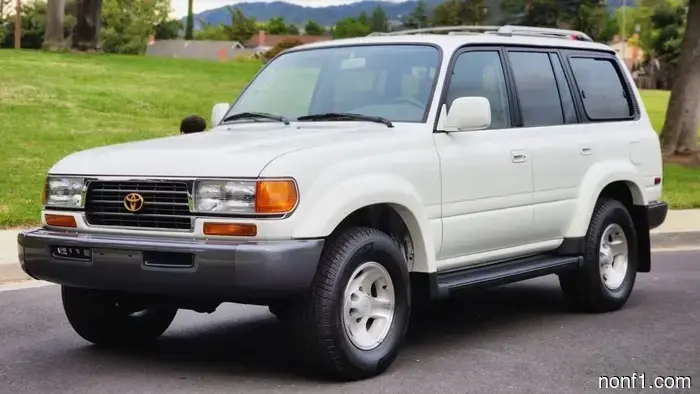 This 80-Series Toyota Land Cruiser is set to fetch a high price at Monterey Car Week.
It might seem modest, but this standard Land Cruiser is already classified as a six-figure vehicle.
This 80-Series Toyota Land Cruiser is set to fetch a high price at Monterey Car Week.
It might seem modest, but this standard Land Cruiser is already classified as a six-figure vehicle.
 Cadillac will soon complete the refinement process of the MAC-26 chassis.
Valtteri Bottas confirmed that Cadillac F1 will soon complete the refinement process for the 2026 car and fully switch to preparing for the next season...
Cadillac will soon complete the refinement process of the MAC-26 chassis.
Valtteri Bottas confirmed that Cadillac F1 will soon complete the refinement process for the 2026 car and fully switch to preparing for the next season...
Is your car able to fit in your garage?
Garages are getting smaller, particularly near major urban areas. Is it even possible to park your personal vehicle inside one?