
How Japan's Language Influences Its Unique Automotive Culture
Toyota
The latest in car news and reviews, no nonsense.
Our daily newsletter delivers the important stories right to your inbox every weekday.
A nation's output influences its culture and even its identity. We recognize this, evident in global phenomena such as K-Pop or Swiss chocolate. Conversely, a country’s culture also shapes what it produces. I contend that, in ways that may surprise you, the language of a people profoundly affects their creative expressions more than anything else.
This influence extends beyond art and food. It's apparent in a country's cultural exports, including automobiles. Take German cars as an example; it’s no surprise that intricately engineered Porsches and BMWs come from a society that has a term for every concept. Similarly, Japan has provided car enthusiasts with countless creations to obsess over, whether it's the Supra, GT-R, drift culture, or customization styles like Bosozoku. The Japanese language is also notably emotive, a quality that is perceptible even to non-speakers.
Language influences everyone’s perception of reality. Thus, it follows that the emotions and sentiments in Japan are largely shaped by their words—both written and spoken. These sentiments manifest in creative pursuits. Concepts and feelings about ephemeral beauty, minimalism, suffering, the natural world, and much more find expression in the carefully designed and constructed cars that some individuals base their identities around.
I aim to illustrate how Japanese individuals convey their worldview, influenced by their native language, through the vehicles they create.
Let’s take a brief detour into the classroom.
The Basics of Japanese
For newcomers, learning the language can be daunting. It contains three different writing systems: hiragana, which is generally used for native Japanese words; katakana, typically reserved for foreign loanwords; and kanji, derived from Chinese characters. The first two systems are syllabaries, representing the 46 basic sounds of spoken Japanese. In contrast, kanji can have multiple readings; for instance, the kanji “生” has an “i” sound in 生きる (ikiru, meaning to live) and an “u” sound in 生まれる (umareru, meaning to be born).
Observing the kanji in those examples, you can see it represents concepts like life or birth. (It can also denote rawness, but that’s another discussion.) In this sense, kanji often serve to express ideas or themes.
Here are a few more examples to clarify my point:
- Mountain (山) symbolizing three peaks in a range
- River (川) depicted as three flowing lines
- Fire (火) represented by sticks and flames
- Car (車) illustrated as a box between two axles
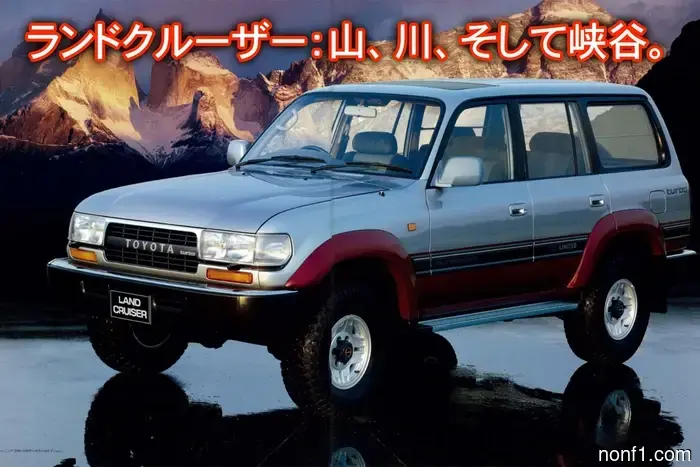
I created a promotional concept for an 80-Series Land Cruiser with basic advertising lines. It reads, “Land Cruiser: Mountains, rivers, and canyons,” transliterated as “Randokurūzā: Yama, kawa, soshite kyōkoku.” The model name is in katakana, since “Land Cruiser” is an English phrase, and the geographical features are represented with the kanji 山, 川, and 峡谷.
Visualizing these aspects is crucial for understanding how the language not only affects Japanese creations but also the deeper worldview of its speakers. Whether using a fountain pen or a mechanical keyboard to write about your environment, the imagery remains vivid throughout the process. The ideas, themes, and objects you’re addressing are clearly alive in your mind.
What Inspired Me
This narrative reflects my own journey. Up until November 2025, I had never attempted to learn another language—no high school Spanish or anything else. That changed after a series of life events, including finding a book by Yoko Tawada titled Exophony. To simply call this an “event” hardly feels exaggerated.
Tawada was born and raised in Japan but has been living in Germany for years. Although she primarily writes fiction, the book I’m highlighting is a collection of essays that delve into her experiences with exophony, a term referring to “the general experience of existing outside of one’s native tongue.” I was astonished by Tawada’s narratives, particularly in how they reveal the new dimensions of existence that open up when stepping outside of one’s linguistic comfort zone.
Around the same time I encountered Exophony, I met my friend Toshi Hayama. We met in 2023 during my first trip to Japan. While it was my first time outside the U.S., Hayama divides his time between Tokyo and Los Angeles, serving as president of Stage 10 Productions, a creative agency involved in various projects including video production, consulting, interpreting, and translation. (Fun fact: Toshi played a significant role in the production team for Fast and Furious: Tokyo Drift.)
That’s Toshi through the years. He’s possibly the only person whose job I envy! Toshi Hayama
Hayama shared a story




Other articles
 Zak Brown is glad that Gianpiero Lambiasi will join McLaren.
Zak Brown commented on Gianpiero Lambiasi's upcoming move to the McLaren team in 2028...
Zak Brown is glad that Gianpiero Lambiasi will join McLaren.
Zak Brown commented on Gianpiero Lambiasi's upcoming move to the McLaren team in 2028...
 AI Is Targeting Car Salespeople, and Honestly, It Completely Makes Sense
The "Pikar Genie" is being proposed as an assistant for showroom personnel. However, would you genuinely prefer interacting with a sales shark over a chatbot?
AI Is Targeting Car Salespeople, and Honestly, It Completely Makes Sense
The "Pikar Genie" is being proposed as an assistant for showroom personnel. However, would you genuinely prefer interacting with a sales shark over a chatbot?
 Receive complimentary tools with your Makita battery purchase at Home Depot.
Purchase a two-pack of 18V LXT 5.0Ah Makita tool batteries and choose from a variety of complimentary tools to accompany your purchase.
Receive complimentary tools with your Makita battery purchase at Home Depot.
Purchase a two-pack of 18V LXT 5.0Ah Makita tool batteries and choose from a variety of complimentary tools to accompany your purchase.
 Ferrari and Pirelli continue tire testing
On Friday, Pirelli tests continued with Ferrari at the Fiorano track, where the Italian team is testing prototypes of intermediate and wet tires for the 2027 season.
Ferrari and Pirelli continue tire testing
On Friday, Pirelli tests continued with Ferrari at the Fiorano track, where the Italian team is testing prototypes of intermediate and wet tires for the 2027 season.
 Bortoleto will visit the Stock Car Pro stage in São Paulo.
The factory team Audi driver will participate in the events of the next stage of the series, which can be considered the Brazilian equivalent of NASCAR...
Bortoleto will visit the Stock Car Pro stage in São Paulo.
The factory team Audi driver will participate in the events of the next stage of the series, which can be considered the Brazilian equivalent of NASCAR...
 AI Is Targeting Car Salespeople and Honestly, It Makes Total Sense
The "Pikar Genie" is being presented as an enhancement for showroom personnel. However, would you genuinely prefer to interact with a aggressive salesperson instead of a chatbot?
AI Is Targeting Car Salespeople and Honestly, It Makes Total Sense
The "Pikar Genie" is being presented as an enhancement for showroom personnel. However, would you genuinely prefer to interact with a aggressive salesperson instead of a chatbot?
How Japan's Language Influences Its Unique Automotive Culture
You don't need to know Japanese to recognize the impact of the language and culture on the cars you love. This is what makes them truly unique.