

Safnauer recalls an unusual way of weather forecasting.
When the Mercedes team first received information before the Canadian Grand Prix about who would start on which tires, they didn't believe it at first, thinking there must have been a mistake. But then, on the starting grid, they saw for themselves that seven out of 22 cars were indeed on intermediate tires, not slicks, even though no rain was expected.
Of course, the teams, including McLaren, which made this clearly erroneous decision that largely predetermined the outcome of the Sunday race, analyzed their actions and had to draw conclusions for the future.
However, in their defense, it can be noted that at the moment the decision was made, the weather situation was still not entirely clear, and if the precipitation had not stopped but intensified, the risk would have been justified. But not this time.
As it turned out later, at McLaren it was a collective team decision, while Audi and Williams left the tire choice to the drivers, and Carlos Sainz started on intermediate tires, for which he later got angry at himself, and despite an extra pit stop, he managed to recover and earn a couple of points. Cadillac had nothing to lose, as the American team's cars were starting the race from the last row anyway, but in any case, Oscar Piastri was right when he said after the finish that they at McLaren "looked foolish" – just like everyone else who made the wrong choice.
The problem of inaccurate weather forecasts is not new to Formula 1, although the most modern technologies are used to compile them. But perhaps methods that could be called "folk" would be more reliable in some situations?
In any case, one of the unusual methods was shared by Otmar Szafnauer, the former head of teams such as Force India/Racing Point/Aston Martin and Alpine F1. This method was used by Japanese engineer Akio Haga, who worked with the Silverstone team until last year.
"Akio always had a box with a May beetle with him," Szafnauer recalled while participating in another episode of the High Performance podcast. "If the beetle was lying on its back, it meant rain was coming. If not, it would be dry."
Back then, the FIA and Formula 1 teams used the services of the French Meteo-France service, which Szafnauer jokingly called Meteo-Chance (the meaning is clear even without translation). And when he was asked whose forecasts were more accurate, Otmar, now the executive director of Van Amersfoort Racing, a team competing in youth series, cheerfully said: "Akio Haga's beetle!"
Rob Smedley also participated in the podcast, having worked as a race engineer at Jordan, Williams, and Ferrari over the years, and he shared a kind of anecdote on the same topic: "At Jordan, Gary Anderson (the technical director) always said: if your knee hurts, it means rain is coming. I just can't remember if it was about the right leg or the left."
Other articles
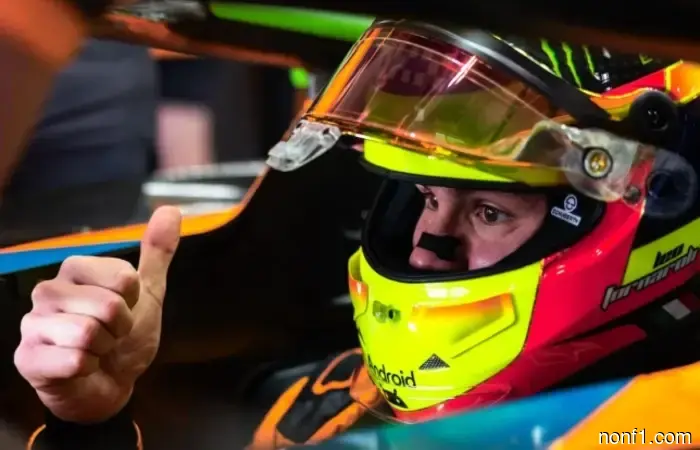 Fornaroli: I have already gotten along well with the team.
This week, Leonardo Fornaroli, a participant in the McLaren youth program and reserve driver for the British team, spent two days testing at the Texas racetrack Circuit of the Americas.
Fornaroli: I have already gotten along well with the team.
This week, Leonardo Fornaroli, a participant in the McLaren youth program and reserve driver for the British team, spent two days testing at the Texas racetrack Circuit of the Americas.
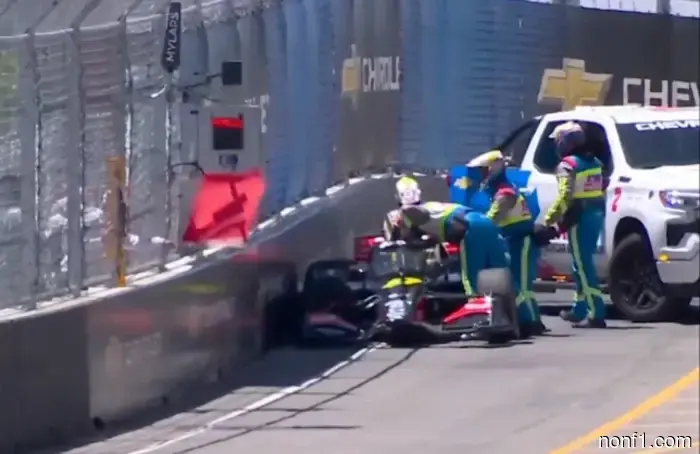 IndyCar: Mick Schumacher crashed the car once again.
This weekend in Detroit, the eighth stage of the IndyCar series is taking place, and for Mick Schumacher, yesterday's qualifying ended in an accident, so on Sunday he will start the race from the second-to-last row...
IndyCar: Mick Schumacher crashed the car once again.
This weekend in Detroit, the eighth stage of the IndyCar series is taking place, and for Mick Schumacher, yesterday's qualifying ended in an accident, so on Sunday he will start the race from the second-to-last row...
 Get this extremely rare Mazdaspeed AZ-1 for a price lower than a brand-new Miata.
Fewer than 5,000 of these gullwing kei cars were produced, with only 150 being Mazdaspeed variants.
Get this extremely rare Mazdaspeed AZ-1 for a price lower than a brand-new Miata.
Fewer than 5,000 of these gullwing kei cars were produced, with only 150 being Mazdaspeed variants.
 AC Cobra GT Coupe Introduces a Fixed Roof to the Classic Model for the First Time
AC Cars has a history spanning 125 years and has been producing Cobras for a bit more than half of that period. However, it has never created one quite like this.
AC Cobra GT Coupe Introduces a Fixed Roof to the Classic Model for the First Time
AC Cars has a history spanning 125 years and has been producing Cobras for a bit more than half of that period. However, it has never created one quite like this.
 Safnauer recalls an unusual way of weather forecasting.
The problem of inaccurate weather forecasts is not new to Formula 1, although the most modern technologies are used to create them. But perhaps the methods that could be called "folk" would be more reliable in some situations?
Safnauer recalls an unusual way of weather forecasting.
The problem of inaccurate weather forecasts is not new to Formula 1, although the most modern technologies are used to create them. But perhaps the methods that could be called "folk" would be more reliable in some situations?
Safnauer recalls an unusual way of weather forecasting.
The problem of inaccurate weather forecasts is not new for Formula 1, although the most modern technologies are used to create them. But perhaps the methods that could be called "folk" would be more reliable in some situations?