
How a Bunch of Classic Cars Came to Be Piled Up Like Firewood in a Canyon in Utah
The most significant automotive news and reviews, no nonsense.
Our complimentary daily newsletter delivers the crucial stories directly to you every weekday.
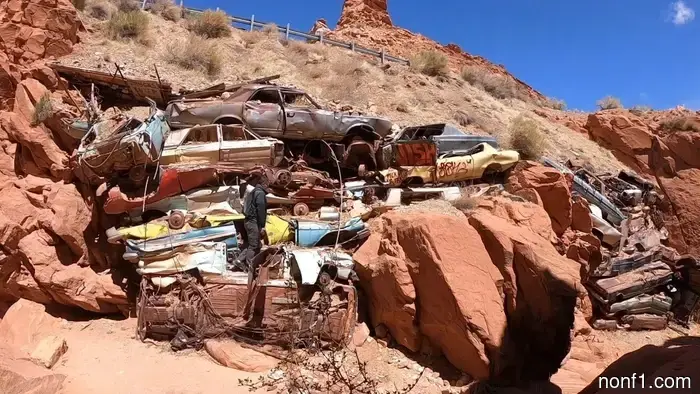
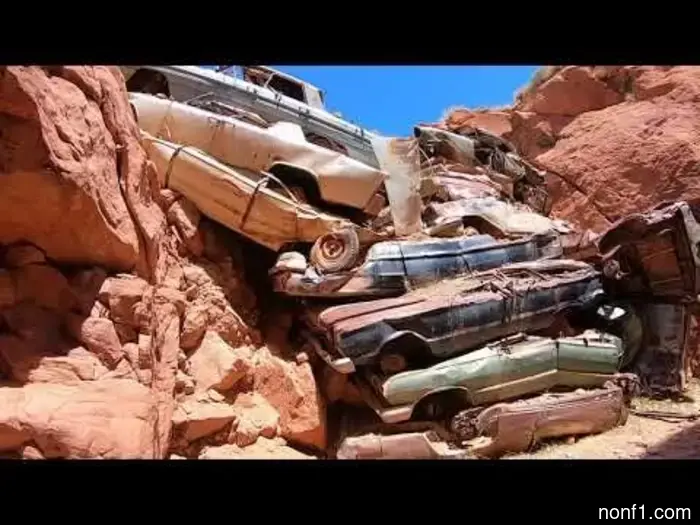
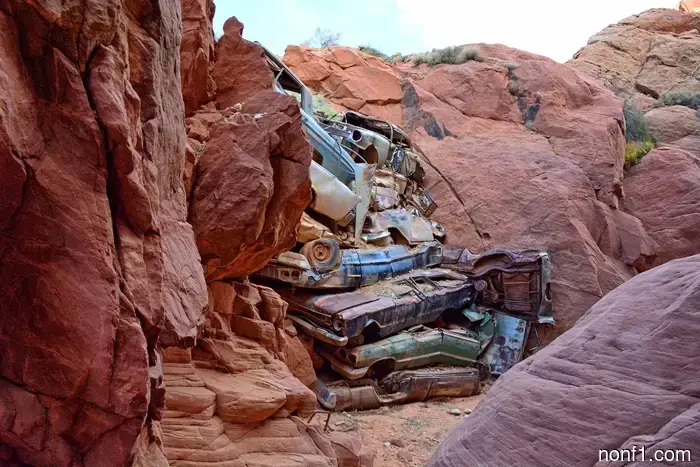
Located right off Highway 89 in Utah near mile marker 25, just above the Arizona border and approximately 80 miles east of Zion National Park, there is an unusual sight: the remnants of Detroit vehicles in various colors, stacked from the canyon floor to the road. These abandoned cars have been here for nearly sixty years, yet they now seem entirely out of place in the desert. There is a valid reason for their presence—or at least there was.
This site is known as Catstair Canyon, and the collection of discarded cars is referred to as the Catstair Riprap. For those unfamiliar with river engineering terminology, "riprap" describes any material placed along riverbanks to safeguard the adjacent land from erosion. This can involve using rocks or concrete, but during the mid-20th century, some specialists preferred utilizing junked car bodies filled with gravel and anchored to a slope.
Although it may seem peculiar today to see a pile of wrecked Bel Airs, Continentals, and Corvairs that are climbable (though we advise exercising caution, as shown by the explorer in the video below), this method was actually somewhat typical in that era.
For instance, along the banks of the Loup River near Columbus, Nebraska, rows of cars line the river, spaced about a car width apart, extending almost as far as one can see. While it looks quite different from the setup in Catstair Canyon, the intent was identical: to slow down water flow and protect the riverbanks from erosion over time. In Catstair's case, the concern was rainwater rushing in those troughs.
Did it achieve its purpose? Yes, but at a clear expense. “It was part of a long-standing practice of regarding rivers as little more than sewers and transportation routes,” stated David L. Bristow from the Nebraska State Historical Society in a 2022 article. “For many years, a town’s riverfront was consistently its most neglected, unattractive, and industrialized area.”
By the early 1970s, the practice of using cars as riprap was starting to decline, according to Hot Rod Magazine’s Steven Rupp, influenced by the Clean Water Act of 1972 and the emergence of new construction methods and technologies. Even though the practice ceased, the junk remains where it is.
Harry Hayashi/Adobe Stock
You can reach the Catstair Riprap by hiking from small dirt parking areas located to the east and west of the site. The west lot is significantly closer and offers an easier path, making it the preferred choice. If you continue past the cars from that side, you’ll encounter a 10-foot drop and a much more challenging trek, according to My Zion Vacation.
Have you visited Catstair Canyon? Feel free to comment below and share your photos if you have any!
Other articles
 Derek Warwick is the third steward of the Monaco Grand Prix.
Derek Warwick has been invited by the FIA to serve as the third steward for the Monaco Grand Prix.
Derek Warwick is the third steward of the Monaco Grand Prix.
Derek Warwick has been invited by the FIA to serve as the third steward for the Monaco Grand Prix.
 Ram Attempted to Market a 'Patriotic T-Shirt' Featuring an AI-Created Tacoma and a Defective American Flag
That's an attractive Ram... oh, hold on.
Ram Attempted to Market a 'Patriotic T-Shirt' Featuring an AI-Created Tacoma and a Defective American Flag
That's an attractive Ram... oh, hold on.
 Leclerc will earn almost 200 million euros in 4 years.
The French press managed to find out the terms of Charles Leclerc's new contract with Ferrari and the driver's salary.
Leclerc will earn almost 200 million euros in 4 years.
The French press managed to find out the terms of Charles Leclerc's new contract with Ferrari and the driver's salary.
 Ram attempted to sell a 'Patriotic T-Shirt' featuring an AI-generated Tacoma and a poorly designed American flag.
That's a cool-looking Ram... oh, hold on.
Ram attempted to sell a 'Patriotic T-Shirt' featuring an AI-generated Tacoma and a poorly designed American flag.
That's a cool-looking Ram... oh, hold on.
 Leclerc will earn almost 200 million euros in 4 years.
The French press managed to find out the terms of Charles Leclerc's new contract with Ferrari and the driver's salary.
Leclerc will earn almost 200 million euros in 4 years.
The French press managed to find out the terms of Charles Leclerc's new contract with Ferrari and the driver's salary.
 The Big Two-Stroke Dirt Bikes are making a comeback: Kawasaki has announced the KX327, its largest model in over two decades.
Kawasaki has not produced a two-stroke motorcycle exceeding 250cc since 2004, but that is about to change.
The Big Two-Stroke Dirt Bikes are making a comeback: Kawasaki has announced the KX327, its largest model in over two decades.
Kawasaki has not produced a two-stroke motorcycle exceeding 250cc since 2004, but that is about to change.
How a Bunch of Classic Cars Came to Be Piled Up Like Firewood in a Canyon in Utah
Just off Highway 89 lies one of the most surreal automotive remnants you'll encounter—and the vintage cars remain for a compelling reason.