

The ADUO program as a source of mutual distrust
Ferrari fans rejoice: Lewis Hamilton confidently won the race in Barcelona, and at the next stage, Scuderia is set to receive upgraded internal combustion engines (ICE) refined according to the ADUO program. This means the chances are increasing that success at the Catalan circuit will not be the only one.
However, there are growing questions about the ADUO program itself; just recently, we quoted Laurent Mekies, the head of Red Bull Racing, and one can understand him, as the ICE produced by Red Bull Powertrains has been recognized as the most powerful according to measurements made by the FIA. Consequently, the team from Milton Keynes will not have the right to refine them – unlike its main competitors.
“Certainly, there needs to be complete clarity on how you assess the efficiency of the ICE,” Mekies believes. “We need to be sure that this rating is compiled correctly... We do not see a single example that would allow us to consider that we surpass our competitors, let alone consistently outpace them.”
Today, the British publication The Race published a text on the same topic that deserves to be quoted almost in full, as it helps to better understand what exactly is wrong with ADUO.
The complexity of Formula 1 is both one of its attractive features and a source of outright absurdity. An example of the latter is the ADUO program, as it leads championship participants to argue about who has fared the worst in developing V6 engines.
ADUO stands for “additional opportunities for modernization and refinement,” and it is a kind of mechanism included in the Formula 1 regulations with the best intentions. However, it has become yet another example that the road to hell is paved with good intentions.
The essence is that the performance of modern power units is determined not by the ICE but by their electrical components. The efficiency of batteries, the quality of software can vary, and engine manufacturers took all this into account when developing their engines, so a certain spread in their parameters is inevitable.
Another drawback of ADUO is that the FIA only measures the torque of the ICE, although federation specialists have information about all the other numerous characteristics of the power units. It turns out that this is, by definition, a multidimensional task, but the approach to solving it is maximally simplified and reduced to one-dimensionality.
However, it would be incorrect to blame the FIA for this, although the federation is to some extent responsible for what is happening. But it is clear that significant roles are played by automotive corporations and their representatives.
“We proposed options, as parameters such as boost pressure, turbine diameters, temperature regimes, etc., could be taken into account,” explained Nicholas Tombasis, FIA director of single-seater racing, back in April. “But the power unit manufacturers then took a unified position and insisted that we should apply simple approaches. From the very beginning, everyone was satisfied that only the power of the power units would be measured – which is what is currently being done.”
Attempts to find a simple solution to an initially very complex problem are always doomed to failure, as such an approach opens up opportunities for various kinds of games. And this is yet another example of how Formula 1 makes a big mistake when it bows to automotive corporations with their whims.
Automakers benefit Formula 1, not only because they invest money in the sport, but also their presence influences the growth of viewer interest. However, trying to please them is an incorrect and dangerous practice.
This must be kept in mind when drafting regulations for the next generation of power units – automotive corporations must not be allowed to blackmail Formula 1, as they have a tendency to threaten to leave the championship. Otherwise, F1 will again receive engines with a whole bouquet of inherent flaws.
If the FIA had taken a firmer stance and insisted on a more correct methodology for measuring efficiency, then the atmosphere in Formula 1 would likely be more normal now, and there would be fewer disputes surrounding ADUO.
If the engines produced by Red Bull Powertrains are indeed the best – and it is currently impossible to confidently judge how effective they are – then their developers deserve all kinds of praise. However, this has turned into unfavorable consequences for the team.
If they mistakenly ended up at the top of the efficiency rating, then the entire methodology on which the ADUO program is based is fundamentally flawed.
The political games that take place outside the racetracks are an integral part of Formula 1; however, excessive simplification of approaches to solving complex problems only creates conditions for various kinds of manipulations and abuses, undermines mutual trust within the paddock, and causes bewilderment outside of it.
Other articles
 You can't purchase a new Defender, Discovery, or Range Rover, and the reason behind this is related to the airbags.
JLR announced a voluntary recall and a stop-sale for all three models after internal testing indicated a possible defect with the driver's airbag, the company informed The Drive.
You can't purchase a new Defender, Discovery, or Range Rover, and the reason behind this is related to the airbags.
JLR announced a voluntary recall and a stop-sale for all three models after internal testing indicated a possible defect with the driver's airbag, the company informed The Drive.
 Aston Martin is preparing the second version of the AMR26 for Hungary.
The Aston Martin team is undergoing a radical modernization of the AMR26 car and plans to present the "specification B" at the Hungarian stage of the season...
Aston Martin is preparing the second version of the AMR26 for Hungary.
The Aston Martin team is undergoing a radical modernization of the AMR26 car and plans to present the "specification B" at the Hungarian stage of the season...
 Isaac Hadjar: Max doesn't ask me for advice.
Isaac Hajar spoke about his relationship with his teammate Max Verstappen.
Isaac Hadjar: Max doesn't ask me for advice.
Isaac Hajar spoke about his relationship with his teammate Max Verstappen.
 Jeep a récemment confirmé le retour du Cherokee Trailhawk.
Le PDG de Jeep, Bob Broderdorf, a déclaré à The Drive que le nouveau Cherokee resterait capable tout-terrain — l'entreprise automobile vise maintenant à tenir cette promesse.
Jeep a récemment confirmé le retour du Cherokee Trailhawk.
Le PDG de Jeep, Bob Broderdorf, a déclaré à The Drive que le nouveau Cherokee resterait capable tout-terrain — l'entreprise automobile vise maintenant à tenir cette promesse.
 Car Enthusiasts Dislike the Honda Prelude, Yet It is Well-Loved in Real Life
I spent a couple of weeks with the Honda Prelude that enthusiasts can't stop raving about, and it was clear there was genuine appreciation for it on the streets.
Car Enthusiasts Dislike the Honda Prelude, Yet It is Well-Loved in Real Life
I spent a couple of weeks with the Honda Prelude that enthusiasts can't stop raving about, and it was clear there was genuine appreciation for it on the streets.
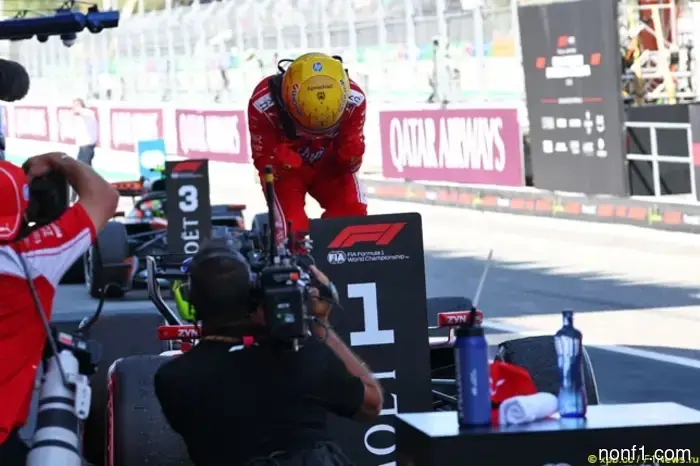 Grand Prix that Lewis Hamilton has never won
In his Formula 1 career, which began in 2007, Lewis Hamilton has started 40 Grands Prix and won 32 of them. But which ones has he never won, and which ones will he never be able to win?
Grand Prix that Lewis Hamilton has never won
In his Formula 1 career, which began in 2007, Lewis Hamilton has started 40 Grands Prix and won 32 of them. But which ones has he never won, and which ones will he never be able to win?
The ADUO program as a source of mutual distrust
The ADUO program is raising more and more questions, and The Race publication has released a text on this topic that deserves to be quoted almost in full...